Medically reviewed by Dr Sin Yong · Last reviewed · 3 min read
Published 13 October 2026 · Reviewed by Dr Sin Yong
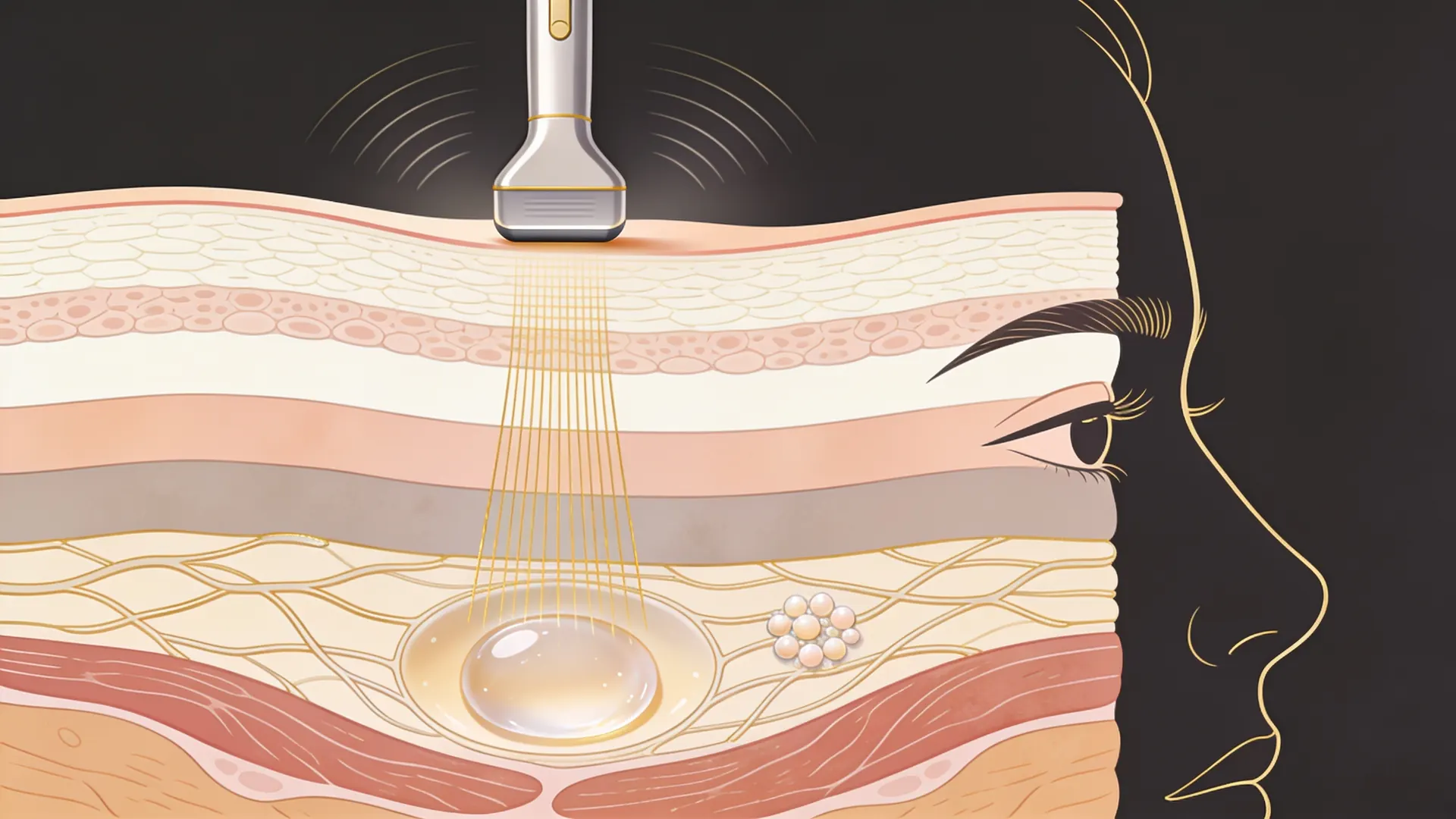
SMAS stands for the superficial musculoaponeurotic system, the continuous fibrous and muscular layer beneath the skin and subcutaneous fat of the face that connects the facial muscles to the dermis and transmits their movement. The SMAS sits at roughly 4.5 mm below the surface over the cheek and jawline and is the layer repositioned in a surgical facelift. Non-surgical lifting devices either heat focal points within it or work on the layers above it.
Key facts
Full name
Superficial musculoaponeurotic system
Depth
Approximately 4.5 mm below the skin surface over the cheek and jaw; continuous with the platysma in the neck
Why it matters
The layer a surgical facelift repositions; the 4.5 mm target of HIFU and Ultherapy
Not reached by
Monopolar radiofrequency, which heats the dermis and subcutaneous layer volumetrically rather than placing focal heat in the SMAS
Where it fits
The SMAS is the reference depth for every lifting treatment on this site. HIFU converges ultrasound so that a point of tissue under 1 mm³ is heated to roughly 60 to 70 °C at 4.5 mm, where the SMAS and platysma are lax along the jawline and beneath the chin, with 3.0 mm for the dermis and 1.5 mm for the superficial dermis; Ultherapy does the same with real-time imaging of the layers to about 8 mm before each line is delivered. Dr Sin Yong's VF Lift – Vertical Facelift works differently: Volnewmer monopolar radiofrequency heats the dermis and subcutaneous layer along vertical vectors and does not place focal heat in the SMAS. At consultation he maps where the SMAS is lax against where volume is missing, because the two need different tools.
Frequently Asked Questions
It is a fibrous and muscular sheet rather than one muscle: a continuous layer that envelops and connects the mimetic muscles of the face to the overlying skin, continuous with the platysma in the neck. Surgeons lift it; focused ultrasound heats points within it.
High-intensity focused ultrasound at the 4.5 mm depth, including Ultherapy and Ultraformer MPT, places focal heat in the SMAS. Monopolar radiofrequency such as Volnewmer heats the dermis and subcutaneous layer and does not target the SMAS.
References
US FDA 510(k) K260618 — Ulthera System (Merz), 2026: indicated to lift the eyebrow, lift lax submental and neck tissue, improve lines and wrinkles of the décolleté, and improve skin laxity on the abdomen, arms and knees. source
Amiri M, et al. Microfocused ultrasound with visualization (MFU-V) effectiveness and safety: a systematic review and meta-analysis. Aesthet Surg J. 2025;45(3):NP86-NP94. doi:10.1093/asj/sjae228. source
Alhaddad M, et al. Randomised split-face comparison of monopolar radiofrequency and microfocused ultrasound with visualisation for laxity (n=20). Dermatol Surg. 2019;45(1):131-139. doi:10.1097/DSS.0000000000001653. source