Published 20 October 2026 · Reviewed by Dr Sin Yong
Menopause skin changes because oestrogen supports collagen, hyaluronic acid, sebum and the skin's water barrier, and all four fall when oestrogen does. The result is dryness, thinning, slower healing and laxity that arrives faster than age alone explains. Dr Sin Yong assesses which layer has changed before anything is planned, and questions about hormone therapy itself go to your GP or gynaecologist.
Short answerMenopause skin is drier, thinner and looser because oestrogen-dependent collagen and hyaluronic acid fall after the final period. Treatment is chosen by layer: barrier care for the surface, hydrating injectables for the dermis, biostimulators and radiofrequency where collagen and recoil have gone. Hormone replacement therapy is a GP or gynaecology decision, not an aesthetic one.
Oestrogen receptors sit on fibroblasts, keratinocytes and sebaceous glands, so collagen production, hyaluronic acid, sebum and water-holding all fall when oestrogen withdraws
Collagen
Published measurements show skin collagen falling steeply in the first years after the menopause and more slowly after that, which is why laxity can seem to arrive suddenly
What you notice
Dryness and a tight feeling after washing, fine crepe lines on the cheeks and neck, thinner skin that bruises more easily, slower healing, and a face that looks deflated rather than wrinkled
Planned by layer
Surface barrier and sun protection first; hydration and collagen in the dermis with skin boosters, Profhilo or a biostimulator; recoil with monopolar radiofrequency; pigment on its own pathway
Not here
Hormone replacement therapy, perimenopausal symptoms, bone and heart screening and intimate dryness beyond the skin are GP and gynaecology decisions; Dr Sin Yong examines the skin and coordinates with that care
The skin is an oestrogen-responsive organ. Fibroblasts in the dermis, keratinocytes in the epidermis, sebaceous glands and hair follicles all carry oestrogen receptors, and oestrogen signals them to make collagen, hyaluronic acid and sebum, to hold water and to repair. Through perimenopause the signal weakens and after the final period it falls to a fraction of what it was. The skin does not stop working; it works with less instruction, and the change shows in every layer at once.
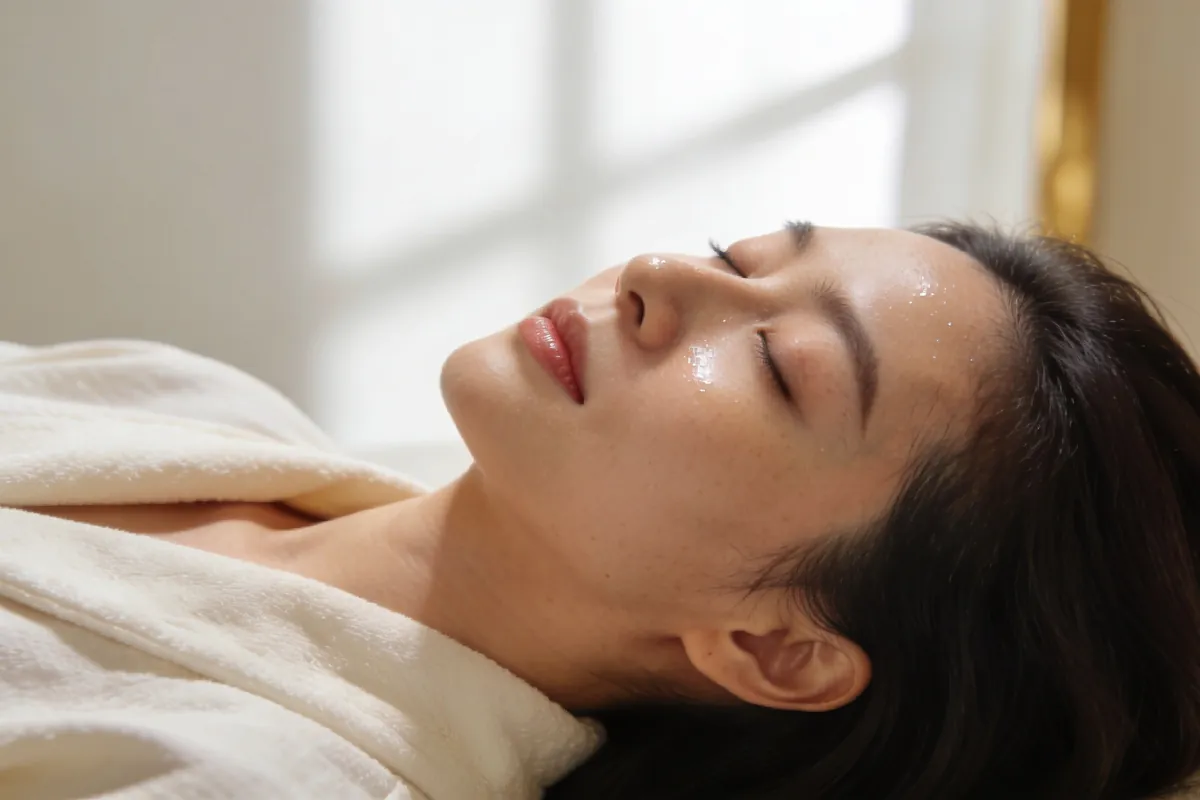
Illustrative image — not a patient.
In the dermis, collagen and elastin are made more slowly and broken down faster, and the ground substance between the fibres holds less water. The dermis becomes thinner and less springy, which is the laxity and the crepe-paper quality people describe on the cheeks, under the chin and on the neck. In the epidermis, cell turnover slows and the lipid barrier is less complete, so water escapes more easily and irritants get in more easily; this is the dryness, the tightness after cleansing and the new sensitivity to products that used to be fine. Sebum falls, which is why skin that was combination for decades turns dry. Wound healing slows and small bruises appear from minor knocks because the dermis gives the blood vessels less support.
Two things make this feel abrupt rather than gradual. First, the published measurements of skin collagen in post-menopausal women show the steepest fall in the first years after the menopause, before the decline flattens. Second, the deep fat compartments of the face and the bone beneath them are also changing with age, so the skin is loosening at the same time as the scaffold under it is shrinking. A face that looked tired at 48 can look deflated at 53 without any single thing having gone wrong.
Dryness, thinning and laxity: how to tell which layer has changed
Most women arrive describing one word, usually 'dull', 'dry' or 'saggy', and the first job in the consultation is to separate the layers, because they are treated differently and treating the wrong one wastes effort. Dr Sin Yong examines the skin with and without make-up, pinches it on the cheek, jaw and neck to see how quickly it recoils, looks at it under magnification for the texture of the surface, and asks about products, sun exposure, sleep, smoking and any medical change, because a thyroid problem or iron deficiency can mimic the dullness of menopausal skin.
What you notice
Layer involved
How it is examined
What it tends to need
Tight after washing, flaky patches, products sting
Epidermal barrier
Surface under magnification; product history
Barrier repair and a simpler routine before any procedure
Dull, fine crepe lines that disappear when the skin is gently stretched
Dermal hydration and collagen
Stretch test; skin quality score
Hydrating injectables; a collagen-stimulating plan
Skin that lifts easily on a pinch and returns slowly
Dermal recoil and the fibrous septa
Pinch-recoil on cheek, jaw and neck
Monopolar radiofrequency on the face and neck
Hollow temples, flat cheeks, a longer upper lip
Deep fat and bone
Comparison with earlier photographs; palpation
Volume restoration where it is genuinely missing, not everywhere
Several layers are usually involved together, and the plan is sequenced rather than done at once. The order Dr Sin Yong follows is the same as for any face after 50: protect and repair the surface, restore hydration and collagen, address recoil, replace volume only where it is missing, and refine the surface last. The aesthetic treatments after 50 guide explains that sequence for the whole face; this page concentrates on the skin itself.
“After the menopause I am not treating wrinkles; I am treating a dermis that has lost its instructions. Hydrate it, give it a reason to make collagen, heat the recoil back, and leave the hormones to the doctor who manages them.”
Dr Sin YongOn planning for menopausal skin
Menopause skin treatment options by layer: boosters, Profhilo, biostimulators and radiofrequency
No single treatment answers oestrogen-deficient skin, because the deficiency touches every layer. The options below are grouped by the layer they act on. Which of them are used, in what order and in what combination, is decided after examination, and some women need only the first group.
Illustrative image — not a patient.
Surface: barrier, sun and retinoids
A bland moisturiser with ceramides, a gentle non-foaming cleanser and daily broad-spectrum sunscreen are the foundation, and in Singapore's ultraviolet index they matter more than any procedure. Topical retinoids remain the evidence-based active for thinning, photo-aged skin and are introduced slowly on menopausal skin because the barrier tolerates less. Prescription options such as tretinoin are discussed at consultation rather than bought online. Topical oestrogen creams for the face are studied in the literature but are not a routine recommendation here; that question belongs with the doctor who manages your hormones.
Dermal hydration: skin boosters and Profhilo
Skin boosters are micro-injections of non-crosslinked hyaluronic acid into the dermis, replacing some of the water-holding ground substance that oestrogen loss has thinned. Profhilo is a high-concentration hybrid hyaluronic acid injected at a small number of points; Dr Sin Yong uses a modified BAP technique so that it spreads through the tissue rather than sitting where it is placed. Neither adds volume or lifts, which is precisely why they suit skin that has lost quality but kept its shape.
Collagen: biostimulators
Where the dermis has thinned and the skin has lost its spring, a collagen biostimulator such as poly-L-lactic acid or polycaprolactone prompts fibroblasts to lay down new collagen gradually. On bone-supported areas such as the temples, cheekbones and jawline, Dr Sin Yong usually chooses a calcium hydroxylapatite or polycaprolactone product. Biostimulators are placed conservatively on menopausal skin, because overfilled faces are among the commonest corrections seen in this practice.
Recoil: monopolar radiofrequency
Skin that lifts easily on a pinch and settles slowly needs heat in the dermis and the fibrous septa beneath it, which is what monopolar radiofrequency does. Dr Sin Yong delivers this as the VF Lift – Vertical Facelift on Volnewmer, planning the face by zone along vertical vectors, or on Thermage FLX. Radiofrequency does not depend on melanin, which matters for Asian skin, and it is chosen over ultrasound-based lifting where the problem is the skin envelope rather than the deeper support layer.
Pigment and redness
Melasma can appear or flare around the menopause, and sun spots accumulated over decades become visible as the skin thins. These are diagnosed before any laser, because the same device helps one and worsens another; the pathway is on melasma treatment and sun spots.
Menopause hair thinning and brittle nails: what belongs where
Hair and nails change on the same hormonal signal, and they are often the first thing a woman notices. Hair follicles carry oestrogen receptors; oestrogen lengthens the growing phase, and when it falls the ratio of oestrogen to androgen shifts, so hair can thin diffusely over the crown and the parting widens. This is female pattern hair loss unmasked by the menopause rather than caused by it, and it sits on its own pathway: the pattern is examined with a dermatoscope, iron, thyroid and vitamin D are checked where the history suggests it, and the medical and procedural options are set out on female hair loss treatment. A sudden shed a few months after a stressful event, an illness or a change in medication is usually telogen effluvium and is managed differently from pattern loss; female hair thinning explains the difference.
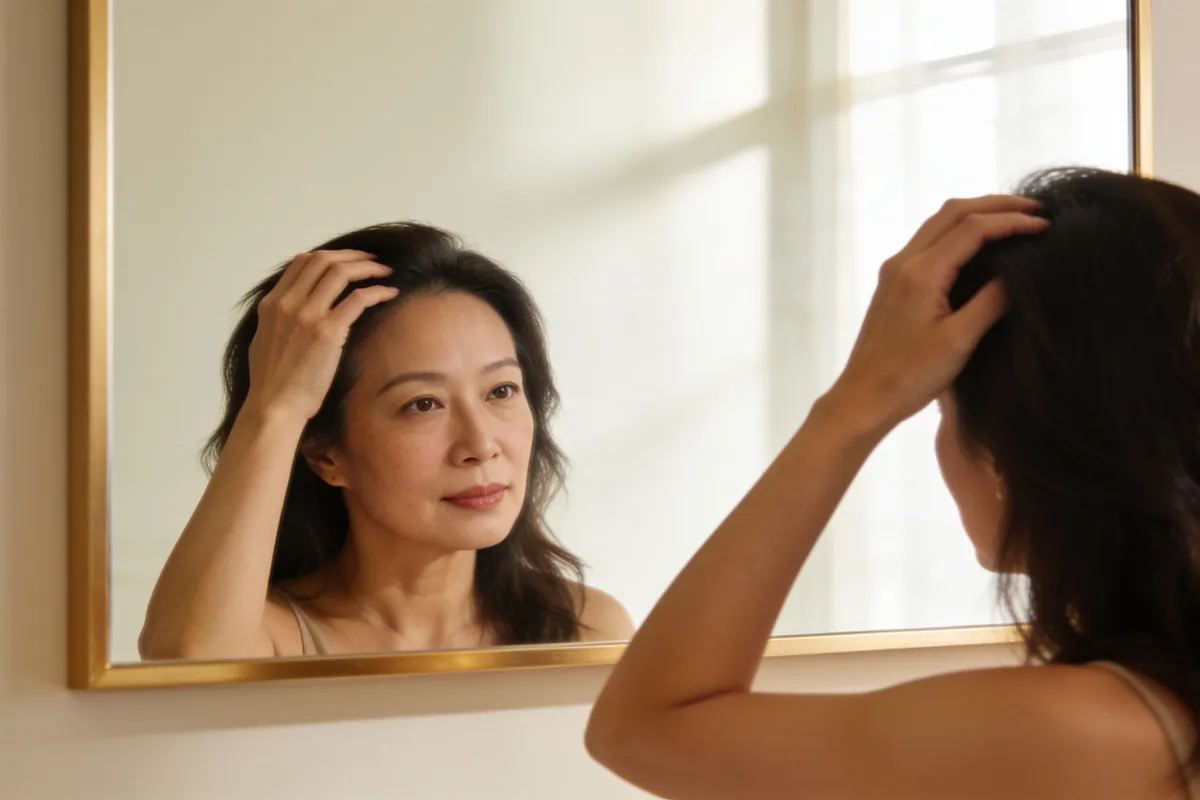
Illustrative image — not a patient.
Facial hair can increase at the chin and upper lip on the same androgen shift. It is removed with laser hair removal once a medical cause has been excluded, and hormone-driven hair that is new, coarse and spreading is discussed with a GP first.
Nails become thinner, more brittle and ridged because the nail matrix also loses oestrogen support, and because the skin around the nail is drier. There is no aesthetic procedure for this. A GP or dermatology specialist checks for thyroid disease, iron deficiency and fungal infection where the change is marked, and the practical advice is gloves for wet work, a cuticle oil and avoiding harsh removers.
Will HRT help my skin, and who should I ask?
This is the question asked most often, and it is the one this clinic does not answer on its own. Hormone replacement therapy is prescribed for menopausal symptoms and, in selected women, for bone protection; its effect on skin collagen has been studied and is discussed in the dermatology literature, but skin appearance is not an indication for it, and the decision weighs breast, cardiovascular and clotting history that an aesthetic consultation is not designed to take. Dr Sin Yong will tell you what the skin shows and what the published evidence says, and will then ask you to take the HRT question to your GP or gynaecologist. If you are already on HRT, say so at consultation, because it changes bruising and the choice of some treatments.
Other things that go to a GP or specialist first
Hot flushes, night sweats, sleep disturbance, mood change and joint pain: menopause care, not skin care.
Vaginal dryness and discomfort: a gynaecology assessment first; the laser option this practice offers for the vaginal lining is described on vaginal tightening and is planned with that care.
Bleeding after the menopause, a breast change, or weight change you cannot explain: medical review before any aesthetic plan.
A rash, persistent itch or a changing mole: referred to dermatology rather than treated around.
Where you already have a GP or a gynaecologist managing the menopause, Dr Sin Yong writes to them with what was found and what was done, so that the two plans do not work against each other.
What decides the plan, and what aftercare looks like
The plan follows the examination, not the menu. The factors that decide it are which layers have changed and how far; whether the face has also lost volume or support, which changes the order; skin phototype, because darker skin needs more care with any heat or light; medical history, including hormone therapy, blood thinners, autoimmune disease and any history of keloids; and what you want to look like, which for most women at this stage is rested rather than different. The fee follows the treatments chosen, the areas and whether they are combined, and is set out in writing after the consultation; the principles are on how we quote.
Aftercare in broad terms
After hydrating or collagen-stimulating injections: small bumps and bruises that settle; no pressure or massage unless instructed; sunscreen daily.
After radiofrequency: warmth and pinkness on the day; avoid saunas and hard exercise for a short period; moisturise and protect from sun.
For everyone: the barrier routine continues indefinitely, because the oestrogen deficit does not reverse, and results are judged at review rather than on the day.
Menopausal skin is maintained, not fixed. The honest version of the plan is a foundation that continues, one or two procedures chosen for the layers that have actually changed, and a review that decides whether anything more is worth doing.
Your next step
1. MessageWhatsApp +65 8023 7170 with what is bothering you. A reply comes from the clinic, not a bot.
2. AssessmentDr Sin Yong examines you himself on Orchard Road, with ultrasound where earlier filler is involved.
3. A plan in writingWhat he would do, what he would not, the fee factors, and the option of no treatment.
Every treatment is performed by Dr Sin Yong personally. Singapore Medical Council registered · invited to share his clinical expertise internationally for CLASSYS, DEKA, Fotona, Hironic and Ilooda.
Bring a list of your medicines, including any hormone therapy, and a photograph of your face from your forties. How consultations work.
Oestrogen keeps the epidermal barrier complete and keeps sebum and dermal hyaluronic acid up. When it falls, the skin loses water faster, makes less oil and holds less water in the dermis, so skin that was combination for decades becomes dry and tight. A simpler, barrier-repairing routine comes before any procedure, and hydrating injectables are considered once the surface is stable.
It accelerates it. Skin collagen falls steeply in the first years after the menopause and the dermis loses its spring, while the deep fat and bone beneath are also changing with age. Whether the loose skin or the lost scaffold is the main driver is decided by examination, because they are treated differently: radiofrequency for recoil, volume restoration only where volume is genuinely missing.
Hormone replacement therapy has been studied for its effect on skin collagen, but skin appearance is not an indication for it, and the decision depends on your breast, heart and clotting history. Dr Sin Yong will explain what the skin shows and what the evidence says, and will ask you to take the HRT decision to your GP or gynaecologist. Tell the clinic if you are already on it.
There is no single answer, because oestrogen loss affects every layer. The surface needs barrier care and sun protection; the dermis may need hydrating injectables or a collagen biostimulator; recoil is addressed with monopolar radiofrequency; pigment has its own pathway. The examination decides which layers have changed and in what order they are treated, and some women need only the foundation.
Hair thinning over the crown is usually female pattern loss unmasked by the hormonal shift and is assessed on its own pathway, with blood tests where the history suggests them. Brittle nails have no aesthetic procedure; a GP checks thyroid, iron and fungal causes where the change is marked, and the practical measures are gloves, cuticle oil and gentler removers.
Often, because Profhilo adds hydration and prompts collagen without adding volume or lifting, which suits skin that has lost quality but kept its shape. Dr Sin Yong injects it with a modified BAP technique after examining the skin. It does not address laxity that lifts on a pinch or hollowing from lost fat, which are planned separately if present.
References
The effect of menopause on the skin and other connective tissues. Gynecological Endocrinology, 2012. source
Estrogens and aging skin. Dermato-Endocrinology, 2013. source
Estrogen-deficient skin: The role of topical therapy. International Journal of Women's Dermatology, 2019. source
A review of the role of estrogen in dermal aging and facial attractiveness in women. Journal of Cosmetic Dermatology, 2018. source
Untangling estrogen therapy for menopausal hair loss: A systematic review. Journal of the American Academy of Dermatology, 2026. source
About this page: written and medically reviewed by Dr Sin Yong, MBBS (NUS), MRCS (Edinburgh) · Last reviewed 20 October 2026 · Illustrative images only, not patients · Editorial policy