Where a PDLLA collagen stimulator is being weighed against a booster, see Juvelook in Singapore.
Main guideSkin booster — what it treats, who it suits, sessions, downtime and what decides the cost, by Dr Sin Yong.
Published 31 October 2026 · Reviewed by Dr Sin Yong
Skin booster myths usually come from one word covering several different products. A skin booster is an injectable placed into the skin to change its quality, meaning hydration, elasticity and texture, rather than its shape. Hyaluronic acid boosters, Profhilo, polynucleotides such as Rejuran and PDLLA collagen stimulators work in different ways. Here are six claims heard in clinic in Singapore, checked against peer-reviewed studies.
Myth 1: "A skin booster is just a filler with a different name"
A skin booster is not a filler. A filler occupies space to restore volume and contour; a booster is spread through the skin to change its quality without adding volume. The evidence on hyaluronic acid boosters reflects that difference. A 2025 systematic review and meta-analysis of hyaluronic acid injected into the skin pooled six studies and found improved hydration and radiance compared with controls, but no significant difference in elasticity. None of the outcomes measured was volume or contour, because that is not what these products are designed to do.
The practical consequence is in the assessment. A hollow cheek needs a filler or, here more often, an energy-based approach; skin that has thinned and lost its bounce needs something else entirely. Giving filler to a skin-quality problem produces a face that is fuller but no better in quality, and giving a booster to a volume problem changes little. Dr Sin Yong examines the skin first and chooses the class after that; the distinction is set out on skin booster.
Myth 2: "Any skin booster does the same job as any other"
Skin boosters do not all do the same job; the classes work through different mechanisms and have different evidence. Hyaluronic acid boosters bind water in the skin. Profhilo is a stable hybrid complex of high- and low-molecular-weight hyaluronic acid, thermally bonded without a chemical cross-linker, placed at defined points to spread through the tissue. A 2016 open-label study of 64 women treated with it at five points on each side of the face, assessed over 16 weeks, reported improvement on clinical and instrumental measures and minor, temporary reactions at the injection sites in about a quarter of participants. Polynucleotides such as Rejuran are DNA-derived polymers aimed at repair and texture, and PDLLA stimulators such as Juvelook prompt collagen gradually.
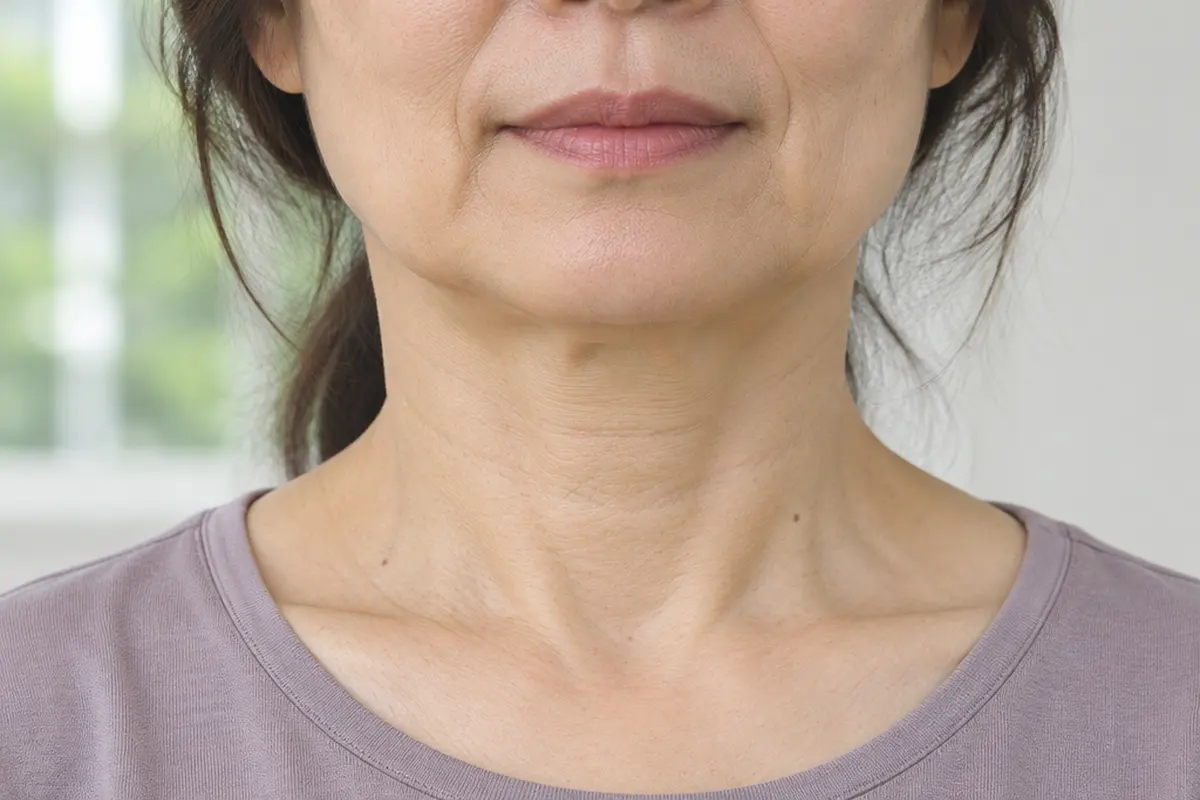
Fine lines on the neck and chest reflect skin quality. Illustrative image, not a patient.
The quality of evidence also differs by class. A 2025 systematic review of polynucleotides in aesthetic medicine found nine studies, of low and moderate quality, with promising results but limited consensus on how they should be used. So the class is chosen by what the skin is short of, not by brand popularity. The classes are compared on skin booster types and which booster suits you.
“A skin booster treats the quality of the skin. A filler occupies space. Most disappointment with boosters starts with confusing the two.”
Dr Sin YongOn what skin boosters are for
Myth 3: "Salmon DNA boosters are unnatural and unsafe"
Polynucleotide boosters are purified DNA-derived polymers, and the published studies report mostly mild, short-lived side effects. Polynucleotides and the closely related polydeoxyribonucleotides have been studied since the 1990s for wound healing and skin regeneration. A 2025 narrative review set out how the two are defined by the length of their chains and proposed a standard naming cutoff, because the terms had been used interchangeably and caused confusion. The 2025 systematic review of polynucleotides found side effects generally mild and transient, though it called for higher-quality studies before firm conclusions.
The real safety point is narrower than the myth. Because polynucleotides are purified from salmon, a known fish allergy is a reason not to use them, and it is asked about before any polynucleotide is placed. Redness, small raised points and occasional bruising at the injection sites are expected. How Rejuran and other polynucleotide boosters are used is on polynucleotide skin boosters.
Myth 4: "Skin boosters lighten pigmentation"
Skin boosters are not a pigment treatment. The 2025 meta-analysis of hyaluronic acid injections that found improved hydration and radiance found no significant change in melanin index, the measure of pigment in the skin, compared with controls. A skin that is better hydrated can look more even in tone under light, but that is not the same as clearing a sun spot, melasma or post-inflammatory marks.
Pigment is diagnosed first and treated with tools aimed at it: topicals and sun protection for every pigment plan, and, where suitable, laser chosen for where the pigment sits. Where a booster fits alongside pigment care is discussed on pigmentation removal, and why boosters and skincare do different jobs on skin boosters vs skincare.
Myth 5: "Skin boosters can't cause lumps"
Lumps after skin boosters are uncommon, but they happen, particularly with collagen stimulators. The small raised blebs at each injection point straight after a booster are expected and flatten as the product spreads; they are not lumps. Persistent nodules are different. A 2024 consensus on poly-D,L-lactic acid (PDLLA) microspheres, the material in collagen-stimulating boosters such as Juvelook, highlighted nodules and granulomas as the adverse effects that careful patient selection and technique aim to minimise.
A lump that persists, grows, hardens or becomes red and painful is examined, with ultrasound where earlier product is involved, rather than massaged or cut out. Hyaluronic acid boosters can be dissolved with hyaluronidase; the PDLLA in collagen-stimulating boosters cannot. Expected and uncommon effects are listed on skin booster side effects, and what is done about a lump on skin booster lumps.
Myth 6: "You see the full effect of a skin booster the next day"
Most of what you see the day after a skin booster is the product sitting in the skin and some swelling, not the effect the treatment is aimed at. Boosters work through hydration and the skin's own response, which develop over weeks. In the 2016 Profhilo study, changes were first measured as significant at four or eight weeks, after two placements a month apart, and were assessed again at sixteen weeks. Polynucleotide and PDLLA effects are described as gradual by their mechanism.
That shapes the plan. The first review is timed once the blebs have dispersed and the skin has had time to respond, and any further placement is decided then according to what the skin is doing. This site does not publish a standard number of sessions, because the number follows the skin and the class used. The hype around single-session glass skin is discussed on glass skin.
Your next step
1. MessageWhatsApp +65 8023 7170 with what is bothering you. A reply comes from the clinic, not a bot.
2. AssessmentDr Sin Yong examines you himself on Orchard Road, with ultrasound where earlier filler is involved.
3. A plan in writingWhat he would do, what he would not, the fee factors, and the option of no treatment.
Every treatment is performed by Dr Sin Yong personally. Singapore Medical Council registered · invited to share his clinical expertise internationally for CLASSYS, DEKA, Fotona, Hironic and Ilooda.
Mention any fish allergy and any filler, booster or collagen stimulator placed before. How consultations work.
No. A filler occupies space to restore volume and contour, while a skin booster is spread through the skin to change its quality without adding volume. A 2025 meta-analysis of hyaluronic acid injections into the skin measured hydration and radiance, not volume. Hollows and sagging are planned with other treatments once the skin has been examined.
No. Hyaluronic acid boosters bind water, Profhilo is a hybrid complex of high- and low-molecular-weight hyaluronic acid placed at defined points, polynucleotides such as Rejuran are DNA-derived polymers aimed at repair, and PDLLA stimulators such as Juvelook prompt collagen gradually. The class is chosen by what the skin is short of.
Polynucleotide boosters are purified DNA-derived polymers, and a 2025 systematic review found their side effects generally mild and transient, though the studies were of low to moderate quality. Because they are purified from salmon, a known fish allergy is a reason not to use them. Redness, small raised points and occasional bruising at injection sites are expected.
Skin boosters are not a pigment treatment. A 2025 meta-analysis of hyaluronic acid injections found no significant change in melanin index compared with controls. Better-hydrated skin can look more even under light, but sun spots, melasma and post-inflammatory marks are diagnosed and treated with topicals, sun protection and, where suitable, laser.
Yes, though uncommonly. The raised blebs straight after injection are expected and flatten as the product spreads. Persistent nodules and granulomas are recognised with collagen stimulators such as PDLLA. A lump that persists, grows, hardens or becomes red and painful should be examined, often with ultrasound, rather than massaged or cut out.
Gradually. What shows the next day is mostly product in the skin and mild swelling. In a 2016 Profhilo study, changes were first measured as significant at four or eight weeks after two placements a month apart. The review is timed once the skin has had time to respond, and any further placement is decided then.
References
The Effect of Local Hyaluronic Acid Injection on Skin Aging: A Systematic Review and Meta-Analysis. Journal of Cosmetic Dermatology (Zhou R, Yu M), 2025. source
Efficacy and tolerance of an injectable medical device containing stable hybrid cooperative complexes of high- and low-molecular-weight hyaluronic acid: a monocentric 16 weeks open-label evaluation. Clinical, Cosmetic and Investigational Dermatology (Sparavigna A, Tenconi B), 2016. source
The Effectiveness of Polynucleotides in Esthetic Medicine: A Systematic Review. Journal of Cosmetic Dermatology (Lampridou S, Bassett S, Cavallini M, Christopoulos G), 2025. source
From Polydeoxyribonucleotides (PDRNs) to Polynucleotides (PNs): Bridging the Gap Between Scientific Definitions, Molecular Insights, and Clinical Applications of Multifunctional Biomolecules. Biomolecules (Marques C, Porcello A, Cerrano M, et al.), 2025. source
Consensus Recommendations for the Reconstitution and Aesthetic Use of Poly-D,L-Lactic Acid Microspheres. Clinical, Cosmetic and Investigational Dermatology (Magacho-Vieira FN, Vieira AO, Soares A Jr, et al.), 2024. source
About this page: written and medically reviewed by Dr Sin Yong, MBBS (NUS), MRCS (Edinburgh) · Last reviewed 6 November 2026 · Illustrative images only, not patients · Editorial policy