Main guideVF Lift – Vertical Facelift — the monopolar radiofrequency lifting protocol Dr Sin Yong performs, what it treats and who it suits.
Published 12 November 2026 · Reviewed by Dr Sin Yong
XERF is a monopolar radiofrequency device for skin tightening made by Cynosure Lutronic. Its difference from the other monopolar platforms is a second frequency: it delivers 2 MHz as well as the usual 6.78 MHz. This page explains what the device does, how the two frequencies differ, and how Dr Sin Yong chooses a monopolar radiofrequency treatment.
Short answerXERF skin tightening heats the skin with monopolar radiofrequency at two frequencies, 6.78 MHz and 2 MHz, with cryogen cooling of the surface. Published modelling and animal histology suggest 6.78 MHz heats along the fibrous septa while 2 MHz heats more broadly and deeply. On Orchard Road, Singapore, Dr Sin Yong builds his VF Lift – Vertical Facelift on Volnewmer at 6.78 MHz, after examining which layer of the face is loose.
XERF is a skin tightening device that uses monopolar radiofrequency. In monopolar radiofrequency, current passes from a treatment tip through the skin to a return pad elsewhere on the body, and the tissue's resistance to that current produces heat. Heating the dermis and the fibrous bands beneath it is the basis of this whole family of treatments.
The maker, Cynosure Lutronic, describes XERF as combining two frequencies, 6.78 MHz and 2 MHz, with three depth settings, cryogen cooling of the skin surface and impedance feedback that reads the skin during delivery. Those are the maker's descriptions, not independent findings.
Thermage FLX, Oligio and Volnewmer all work at 6.78 MHz alone. The background to the category is on the monopolar radiofrequency page.
What do the two XERF frequencies do differently?
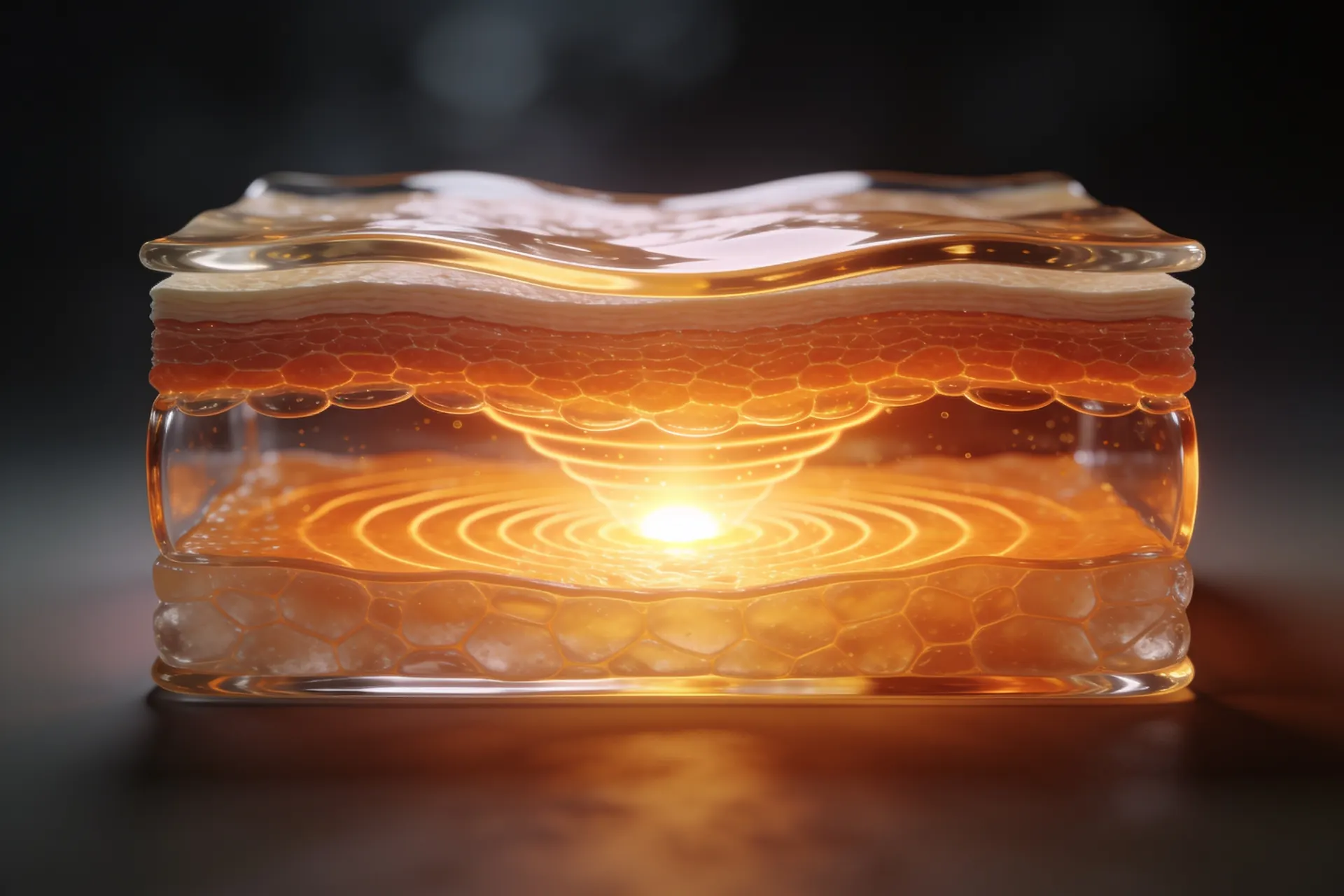
Frequency helps decide where radiofrequency heat collects. Published modelling and animal histology comparing the two frequencies found that 6.78 MHz produced localised heating along the fibrous septa within the fat under the skin, while 2 MHz produced broader, deeper bulk heating within the fat itself. No fat cell death was seen at either setting (Ko et al., Lasers in Medical Science, 2025).
How much skin can be pinched gives a rough idea of laxity. Illustrative image, not a patient.
That is evidence about mechanism, from modelling and animal tissue. It is not a clinical trial comparing outcomes in patients, it was not a test of Volnewmer, and it should not be read as proof that one device gives a better result than another.
The distinction matters for the face. The septa are the scaffolding that holds the facial fat pads in position. Heating along the septa works on that support. Heating the fat in bulk is a different aim, and on a face that is already losing volume it deserves a careful conversation first.
XERF vs Volnewmer, Oligio and Thermage FLX
The four monopolar radiofrequency platforms most often compared in Singapore, side by side. The differences are narrower than the advertising suggests.
Swipe sideways to see the whole table.
Device
Maker
Frequency
Surface cooling
Part of the VF Lift – Vertical Facelift
XERF
Cynosure Lutronic
6.78 MHz and 2 MHz
Cryogen
No
Volnewmer
CLASSYS
6.78 MHz
Continuous water cooling
Yes
Oligio
Jeisys
6.78 MHz
Contact cooling
No
Thermage FLX
Solta Medical
6.78 MHz, pulsed
Cryogen spray
No
The three 6.78 MHz platforms are compared in detail under Oligio vs Thermage vs Volnewmer, and the two used most here under Thermage vs Volnewmer. Dr Sin Yong is a Global Key Opinion Leader for CLASSYS, the maker of Volnewmer, and for Lutronic, the maker of XERF, and says so wherever he compares devices.
Who might XERF suit, and who should look elsewhere?
Monopolar radiofrequency of any brand is aimed at mild to moderate skin laxity: skin that has lost some firmness, early jowling, a softer jawline. It does not lift descended fat pads the way surgery repositions them, and it does not replace lost volume.
It is usually not the tool when the main problem is heavy jowl fat, a marked excess of skin, or a face that has hollowed. Those call for a different approach, and sometimes a surgical opinion.
People with a pacemaker or another implanted electronic device, and those who are pregnant, are not treated with monopolar radiofrequency. Metal implants in the treatment area, active skin infection and some skin conditions also need a doctor's decision first.
What are the risks of XERF and other monopolar RF?
The expected effects are redness, warmth and mild swelling that settle. The risks that matter are burns and blisters where the tip loses even contact or the energy is too high for the area, tingling or altered sensation along a nerve, and, rarely, a dent where fat under the skin has been lost.
These risks belong to the energy type, not to one brand. They are discussed for the platform used here under Volnewmer side effects.
How does Dr Sin Yong choose a skin tightening treatment?
For skin tightening and lifting, Dr Sin Yong uses Volnewmer monopolar radiofrequency at 6.78 MHz within his VF Lift – Vertical Facelift, which works along vertical vectors and treats the fat compartments as structure to keep. Where laxity sits with loose fat, he considers Time Freeze Laser LCLR®.
He examines the face first, at rest and in movement, to see which layer has loosened. He performs every treatment himself on Orchard Road, Singapore, and the plan, including the option of no treatment, is set out in writing.
Your next step
1. MessageWhatsApp the clinic with what is bothering you. A reply comes from the clinic, not a bot.
2. AssessmentDr Sin Yong examines you himself on Orchard Road, Singapore.
3. A plan in writingWhat he would do, what he would not, the fee factors, and the option of no treatment.
Every treatment is performed by Dr Sin Yong personally. Singapore Medical Council registered · invited to share his clinical expertise internationally for CLASSYS, DEKA, Fotona, Hironic and Ilooda.
Skin tightening here starts with an examination of which layer is loose. How consultations work.
XERF skin tightening is a treatment that heats the skin with monopolar radiofrequency to firm mild to moderate laxity. The device is made by Cynosure Lutronic and delivers two frequencies, 6.78 MHz and 2 MHz, with cryogen cooling of the skin surface. Dr Sin Yong's own lifting protocol, the VF Lift – Vertical Facelift, is built on Volnewmer at 6.78 MHz.
Thermage FLX and Volnewmer deliver monopolar radiofrequency at 6.78 MHz only. XERF adds a second, lower frequency at 2 MHz. Published modelling and animal histology link 6.78 MHz to heating along the fibrous septa and 2 MHz to broader, deeper heating. The cooling method also differs: cryogen on XERF and Thermage FLX, continuous water cooling on Volnewmer.
No head-to-head clinical trial shows one giving better outcomes than the other. They heat tissue in somewhat different patterns, so the choice depends on which layer of the face has loosened and whether deeper bulk heating is wanted at all. That is decided at an examination, not from a device name.
In the published animal work comparing the two frequencies, no fat cell death was seen at either 6.78 MHz or 2 MHz. Any monopolar radiofrequency device can, rarely, cause a dent from fat loss if energy is too high for the area. If you are concerned about losing facial volume, raise it before any heat-based treatment.
For skin tightening and early laxity, Dr Sin Yong uses Volnewmer monopolar radiofrequency in his VF Lift – Vertical Facelift, and Time Freeze Laser LCLR® where loose fat is part of the picture. He examines the face first and performs every treatment himself on Orchard Road, Singapore.
People with a pacemaker or another implanted electronic device, and those who are pregnant. Metal implants in the treatment area, active skin infection and some skin conditions need a doctor's decision first.
References
Ko, et al. Modelling and animal histology study comparing monopolar radiofrequency at 6.78 MHz and 2 MHz.
Cynosure Lutronic. XERF product information (manufacturer description of frequencies, depth settings and cooling). None, None. source
About this page: written and medically reviewed by Dr Sin Yong, MBBS (NUS), MRCS (Edinburgh) · Last reviewed 12 November 2026 · Illustrative images only, not patients · Editorial policy