Medically reviewed by Dr Sin Yong · Last reviewed · 11 min read
Brown, blue-purple and shadow circles have different causes; see dark eye circles for which type is which.
In short: A syringoma is a harmless growth of sweat-duct tissue; syringomas show as firm, skin-coloured bumps, usually clustered on the lower eyelids, that cannot be squeezed out. They are not milia and not cholesterol deposits, and removal is optional and gradual.
This topic is part of the main guide to milia, which covers what it treats, who it suits, the risks and how Dr Sin Yong approaches it.
A syringoma is a small, benign growth of sweat-duct tissue in the dermis, usually seen as clusters of firm, skin-coloured to yellowish bumps on the lower eyelids. Unlike milia, there is nothing inside to extract, and unlike xanthelasma, syringomas are not linked to cholesterol. They are harmless, so treatment is optional. Ablative laser and fine-tip electrosurgery can flatten them, but because the growth extends into the dermis, recurrence is common and some mark is possible.
Illustrative. Small bumps around the eyes can look alike but are made of different things.
Your assessment
What happens at your assessment
Dr Sin Yong examines you himselfHe looks at and feels the area, and goes through what was done and when.
You hear what he findsHe explains what has happened in the skin and tissue, in plain words.
You decideHe sets out the options: treat, monitor or leave alone. Nothing is done on the day unless you choose it.
Who you will see: Dr Sin Yong. He performs every assessment and treatment himself.
Syringoma is a benign growth of sweat-duct tissue in the dermis, seen as clusters of firm, skin-coloured to yellowish bumps on the lower eyelids. Unlike milia there is nothing to extract, and unlike xanthelasma it is not linked to cholesterol. Treatment is optional; ablative laser or fine-tip electrosurgery can flatten them, and recurrence is common.
Key facts
What it is
A benign growth of eccrine sweat-duct tissue within the dermis
Typical look
Firm, skin-coloured to yellowish, flat-topped bumps of about 1 to 3 mm, often in symmetrical clusters
Favourite sites
Lower eyelids and upper cheeks; less often the neck, chest, underarms or elsewhere
Who gets them
More common in women, usually from adolescence or early adulthood, and more often seen in Asian skin
What is inside
Solid tissue: no keratin pearl or oil that can be squeezed out
Treatment options
Ablative laser, fine-tip electrosurgery and other methods, chosen at assessment
Recurrence
Common, because the growth extends deeper than superficial treatment reaches
What is a syringoma, and why does it cluster under the eyes?
A syringoma is a benign growth of sweat-duct tissue. It arises from the part of the eccrine sweat duct that runs through the skin, forming small nests of duct-like structures within the dermis. On the surface that looks like a firm bump of about 1 to 3 mm, skin-coloured to faintly yellow, flat-topped rather than domed. The medical word for it is a tumour, which sounds alarming, but here it simply means a growth: syringomas are not cancerous and are not known to become so.
They have a strong preference for the lower eyelids and upper cheeks, usually on both sides, often appearing as clusters that become more noticeable over the years. They are more common in women, typically appear from adolescence or early adulthood, are seen more often in people of Asian heritage, and can run in families. Less often they appear on the neck, chest, underarms or other sites, and an uncommon eruptive form produces many lesions across the body at once.
Most syringomas cause no symptoms. Their importance is cosmetic, and because they sit on the most looked-at skin of the face, they are a frequent reason for an under-eye consultation that turns out not to be about dark circles or eye bags at all. In most cases the diagnosis is made by examination under good light and magnification; a small biopsy is reserved for clusters that look unusual.
Syringoma, milia or xanthelasma: how are they different?
The three are often confused because all are small bumps around the eyes, but they are made of different things. A milium is a tiny sealed cyst of keratin: pearly white, firm and dome-shaped, cleared by opening its roof and expressing the pearl. A syringoma is solid sweat-duct tissue: skin-coloured, flatter and clustered, with nothing inside to express. Xanthelasma is a soft yellow plaque of lipid-laden cells, most often near the inner upper eyelid, and it raises a cholesterol question the other two do not.
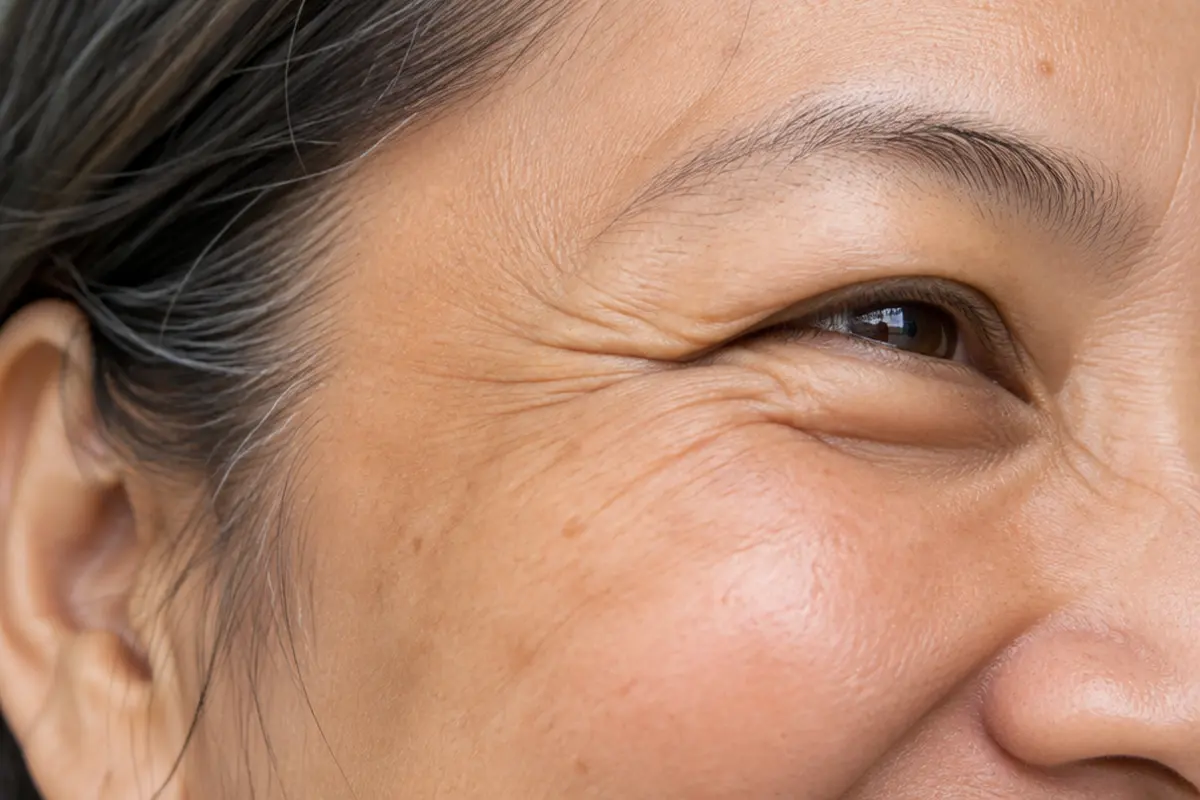
Lines that appear with smiling are from muscle movement. Illustrative image, not a patient.
The distinction changes what happens next. Milia respond to extraction, which is quick. Syringomas do not, and picking at them in the belief that they are milia only inflames the skin, which in Asian skin can leave a brown mark that outlasts the original bump. Xanthelasma prompts a fasting lipid check before any removal is planned. Getting the diagnosis right before treatment matters more on the eyelid than almost anywhere else, because the skin is thin and the margin for error is small.
Other lesions can mimic syringomas too. Sebaceous hyperplasia forms yellowish bumps with a small central dip, usually on the forehead and cheeks. Rarely, a skin cancer of sweat-duct origin can look similar when it forms a firm plaque. A cluster that is spreading, firm and plaque-like, or behaving differently from the classic pattern, is examined with that in mind, and sampled if there is doubt.
“A milium is a sealed pearl, not a blocked pore — there is no exit to squeeze it through, only skin to damage trying.”
Dr Sin YongOn why under-eye bumps should not be squeezed
What causes syringoma, and can it be prevented?
Syringoma is caused by an overgrowth of cells from the eccrine sweat ducts in the dermis, and the exact trigger is not known. What is known is who tends to get it, and why it often appears or grows at certain stages of life. It cannot be prevented with skincare, diet or cleansing, because it does not start from a blocked pore.
What makes syringoma more likely
Hormones. Syringomas are more common in women, often appear around puberty, and have been described growing in pregnancy and before periods. One laboratory study found progesterone receptors in most syringoma cells, although a larger Korean series did not, so the hormonal link is likely but not settled.
Family tendency. They can run in families.
Ethnicity. They are seen more often in people of East Asian heritage. In a Korean clinic series, women outnumbered men by more than six to one and the eyelids were the commonest site.
Some medical conditions. They are more common in Down syndrome, and a clear-cell type is associated with diabetes.
Lookalikes a doctor rules out
Besides milia and xanthelasma, the bumps can be confused with flat warts, which are skin-coloured, slightly rough and can spread in a line where skin has been scratched, and which are contagious, unlike syringoma. Sebaceous hyperplasia has a small central dip, and small moles carry pigment. Examination under magnification usually settles the question; a sample is taken only when a cluster looks unusual.
In Asian skin
The practical risk is a brown mark. Squeezing, needling or acid applied to a syringoma inflames the thin eyelid skin, and in Asian skin that inflammation can leave post-inflammatory pigment that is more noticeable than the bump.
What you can do at home, and what you cannot
You can protect the area from the sun, use make-up to blend the bumps, and leave them alone. You cannot extract a syringoma, because there is nothing inside to release; that is the key difference from milia. Creams and scrubs do not reach the dermis where the growth sits.
See a doctor if the bumps spread quickly, appear on the body, itch, change in character or form a firm plaque, or if you are not sure what they are. Where flattening is wanted, the method is chosen after examination; at this clinic that includes the fractional CO2 laser on the Tetra Pro.
Why do syringomas keep coming back?
Syringomas recur because of where they sit. The growth lies within the dermis and can extend deeper than it appears from the surface, so treatment that flattens the visible bump may leave duct tissue behind. That residual tissue can re-form a bump over time, which is why recurrence after treatment is described across the different methods.
Treating more deeply is not a simple answer. The lower eyelid has some of the thinnest skin on the body, and removing tissue to the full depth of a syringoma risks scarring, textural change or loss of pigment, trade-offs that can be more noticeable than the bump itself. Treatment of under-eye syringomas therefore aims for a balance: enough depth to flatten the lesion, conservative enough to protect the eyelid, accepting that some lesions may need attention again later.
New syringomas can also appear alongside treated ones, because the tendency to form them is constitutional. That is not a failure of treatment; it is the nature of the condition, and it is worth knowing before deciding whether, and how, to treat. Some people choose to leave syringomas alone once they understand this, which is a reasonable decision for a harmless lesion.
What treatment options exist for syringoma?
Treatment is optional, because syringomas are harmless. Where someone wants them flattened, the methods described in the medical literature include ablative laser, using carbon dioxide or erbium wavelengths; fine-tip electrosurgery or radiofrequency; and, for selected lesions, excision or chemical approaches. Topical retinoids are sometimes tried but are not reliable on their own for established lesions.
Ablative laser vaporises tissue in controlled layers, so each bump can be taken down while the skin between bumps is spared. Electrosurgery places a very fine energy tip into each lesion. Some clinicians use insulated radiofrequency needles, which deliver energy within the dermis while limiting heat at the surface; a published case in which two methods were compared side by side on the neck illustrates how much the method and settings shape healing. Which approach suits a given cluster depends on the number and depth of lesions, their site and your skin type, and it is discussed at assessment.
Cryotherapy is less suited to darker skin around the eyes, because freezing can leave pale patches, and the possibility of pigment loss is something to discuss before any method is chosen. This is one reason energy-based methods with careful depth control are commonly used in Asian skin.
On the day, the area is cleansed, the eyes are protected, and local or topical anaesthetic is applied before each lesion is treated. Small crusts then form over the treated bumps and separate as the skin heals. Eye make-up is kept off the sites until they have closed, rubbing is avoided, and daily sun protection helps limit darkening while the skin settles.
Syringoma removal options compared: which method for which cluster?
Syringoma removal is optional, so the choice of method is a weighing of how much the cluster shows against the chance of recurrence and a mark. Each method takes the bump down in a different way, and none removes the tendency to form new ones. The table sets the methods described in the medical literature side by side, so you can see what each trades.
Method
What it does
Tends to suit
Trade-off
Ablative laser (CO2 or erbium)
Vaporises tissue in controlled layers, bump by bump, sparing the skin between
Clusters on the lower lid where depth control matters
Redness and crusting while healing; darkening in Asian skin; recurrence is common
Fine-tip electrosurgery or radiofrequency
Places a very fine energy tip into each lesion
Scattered or smaller lesions
Small crusts; a pale or textured mark is possible
Insulated radiofrequency needles
Delivers energy within the dermis while limiting heat at the surface
Selected lesions, as described in published comparisons
Evidence is limited to small studies
Excision or chemical approaches
Removes or breaks down a single lesion
Selected, isolated lesions
A mark at each site; not practical for a dense cluster
Cryotherapy
Freezes the lesion
Less often chosen around the eyes in darker skin
Pale patches are a particular risk in Asian skin
Creams and topical retinoids
Act on the surface
Not reliable for established lesions
The growth sits in the dermis, below where creams act
What decides the method is the number and depth of lesions, how close they sit to the lashes and lid margin, and your skin type. In Fitzpatrick III to V skin, a brown mark after ablative treatment is the main risk and can last longer than the bump did, which is why a conservative, staged approach is common. Dr Sin Yong examines the under-eye under magnification before any treatment is discussed, because syringoma is often the real answer to a consultation that began with dark circles or eye bags. If the bumps turn out to be milia or xanthelasma, the plan is different again. Leaving them alone is a reasonable choice for a harmless lesion, and it is set out alongside the treatment options.
What can treatment realistically achieve, and what are its limits?
The realistic aim is a flatter, less noticeable cluster, not skin with no trace of syringomas. Treated lesions can recur and untreated ones can emerge. The healing eyelid can show redness and crusting for a while and, in Asian skin, a period of darkening that needs sun protection and patience. Occasionally a pale or slightly textured mark remains.
For that reason, conservative staging is common: a limited group of lesions, or a lighter pass, first, then review once the skin has healed, then a decision about whether to do more. Response varies between individuals, and the plan is adjusted to how your skin behaves rather than fixed in advance.
It also helps to separate syringomas from the rest of the under-eye picture. Hollowing, shadow, pigment and fine crepey lines are different problems with different treatments, and flattening bumps does not change them. Those distinctions are set out on the page on types of dark eye circles, and fine lines have their own assessment under under-eye lines.
What should you avoid, and when should you see a doctor?
Home extraction, needling and acid pens should be avoided. A syringoma is solid tissue, so there is nothing to release, and uncontrolled injury on the lower eyelid risks infection, scarring and pigment change close to the eye. Scrubs and over-the-counter bump-removal products do not reach the dermis where the growth sits, and they irritate the thin skin around it.
See a doctor if the bumps are new and spreading quickly, appear across the body, change in character or become a firm plaque, or if you are not sure whether they are syringomas, milia or xanthelasma. Syringomas are also more common in some conditions, including Down syndrome, and a rarer clear-cell type is associated with diabetes, so a doctor may ask about your general health.
Cost depends on the number and site of lesions treated, the method and how treatment is staged. This site does not publish fees; they are set out at consultation, after examination and before anything is agreed. Dr Sin Yong, MBBS (NUS), MRCS (Edinburgh), MSc Aesthetic Medicine with Distinction (Queen Mary, London), MSc Practical Dermatology (Cardiff), examines eye-area lesions personally on Orchard Road. Where treatment is suitable, Dr Sin Yong treats syringoma with the fractional CO2 laser on the Tetra Pro or with an erbium:YAG laser, chosen after that assessment.
Key takeaways
A syringoma is a benign growth of sweat-duct tissue in the dermis, usually clustered on the lower eyelids and upper cheeks, and it is not cancerous.
Unlike a milium, a syringoma is solid with nothing inside to express, so squeezing, needling or acid pens inflame the thin eyelid skin and can leave a brown mark.
Syringomas can recur after treatment because the growth can extend deeper than it appears, and new ones can form because the tendency is constitutional.
Treatment is optional; where flattening is wanted, Dr Sin Yong uses the fractional CO2 laser on the Tetra Pro or an erbium:YAG laser, chosen after examination and often staged conservatively.
In Fitzpatrick III to V skin a brown mark after ablative treatment is the main risk, so sun protection while the skin heals is part of the plan.
Bumps that spread quickly, appear across the body, change in character or form a firm plaque should be examined by a doctor.
Related Related: sebaceous hyperplasia — the yellow bumps on oily skin, their lookalikes, and how each is flattened.
No. A syringoma is a harmless overgrowth of sweat-duct tissue in the skin, not an infection, so it cannot spread to other people or to other parts of your own face through touch, towels or make-up. Flat warts can look similar and are contagious, which is one reason clusters of small skin-coloured bumps around the eyes are examined before anything is done to them.
Classic under-eye syringomas tend to persist and can slowly increase in number or size over the years, and hormonal change such as puberty or pregnancy has been described as a time when they grow. They do not turn into cancer. A cluster that spreads quickly, appears on the body or turns into a firm plaque should be examined rather than assumed to be ordinary syringoma.
It can be. Syringomas sometimes run in families, and they are more common in women and in people of East Asian heritage, which suggests a genetic tendency. Having a parent with syringomas does not mean you will develop them, and nothing in skincare or diet is known to prevent them. If several family members have similar bumps, it is worth mentioning at the examination.
Syringoma removal is optional and cosmetic. After an examination under magnification, the bumps can be flattened with ablative CO2 or erbium laser, fine-tip electrosurgery or radiofrequency, usually a limited group first with review once the skin has healed. Treated lesions can recur and new ones can appear, and darkening while healing is the main risk in Asian skin, so expectations are set before anything is done.
It can. Small crusts form and separate as the skin heals, and in Asian skin the treated sites can darken for a while, which needs sun protection and patience. Occasionally a pale or slightly textured mark remains. The risk rises with depth, which is why treatment on thin eyelid skin is kept conservative and staged rather than aggressive.
Yes. The lower eyelids and upper cheeks are the usual sites, but syringomas can appear on the neck, chest, underarms and elsewhere, and an uncommon eruptive form produces many lesions across the body at once. Bumps that are spreading quickly, appear across the body or change in character should be examined rather than assumed to be syringomas.
Syringomas are harmless, so treatment is optional. Where someone wants them flattened, ablative CO2 or erbium laser, fine-tip electrosurgery or radiofrequency take each bump down while sparing the skin between them, usually staged conservatively with a review once healed. Creams, scrubs and home extraction do not reach the dermis where the growth sits. Treated lesions can recur and new ones can appear, and darkening while the skin heals is a risk in Asian skin.
Firm, skin-coloured or yellowish bumps clustered on the lower eyelids that cannot be squeezed out are often syringomas, which are benign sweat-duct growths. Other possibilities include xanthelasma, sebaceous hyperplasia and small moles, so a doctor examines them before any treatment.
A syringoma is a benign growth of sweat-duct tissue in the dermis, usually seen as small, firm, skin-coloured bumps clustered on the lower eyelids. It is harmless and not contagious, and treatment is optional.
No. Milia are sealed cysts of keratin that can be extracted through a tiny opening. Syringomas are solid sweat-duct tissue with nothing inside to express, so extraction does not clear them and squeezing only inflames the skin.
No, that is xanthelasma. Xanthelasma forms soft yellow plaques, often near the inner upper eyelid, and is linked to blood lipids. Syringomas are sweat-duct growths with no cholesterol association, although the two can look alike.
Because the growth sits within the dermis and can extend deeper than it looks, treatment that flattens the visible bump on thin eyelid skin may leave tissue behind. New lesions can also form nearby. Recurrence is described across all methods.
Rarely. Classic under-eye syringomas tend to persist or slowly increase. The eruptive form, which produces many lesions across the body, has occasionally been reported to regress without treatment.
It can be, with eye protection, careful depth control and settings adjusted for skin type. Risks include redness and crusting while healing, darkening in Asian skin and occasionally a pale or textured mark, which are discussed before treatment.
Not reliably. Topical retinoids are sometimes tried, but established syringomas sit in the dermis, below where creams act effectively. Over-the-counter bump-removal products and acid pens are not advised near the eyes.
Prices are not published on this site. Cost depends on how many lesions are treated, where they are, the method used and how treatment is staged, and it is set out at consultation.
Comparison of microinsulated needle radiofrequency and carbon dioxide laser ablation for the treatment of syringoma. Dermatologic Therapy, 2019. source
Progesterone receptor positivity supports hormonal control of syringomas. Journal of Cutaneous Pathology, 1995. pubmed.ncbi.nlm.nih.gov
Syringoma: a clinicopathologic and immunohistologic study and results of treatment. Yonsei Medical Journal, 2007. pubmed.ncbi.nlm.nih.gov