Main guidePico laser Singapore — what it treats, who it suits, sessions, downtime and what decides the cost, by Dr Sin Yong.
Published 31 October 2026 · Reviewed by Dr Sin Yong
Pico laser myths tend to run in two directions: that it damages skin, or that it fixes every brown mark. Neither matches the evidence. Picosecond lasers deliver energy in trillionths of a second, mainly fragmenting pigment by a pressure effect, and the published trials support them for some pigment and not others. Here are six claims heard in clinic in Singapore, each checked against peer-reviewed studies.
There is no clinical evidence that pico laser thins the skin. The worry usually comes from confusing laser toning with peeling or bleaching, or from the dryness some people notice afterwards. The studies that have looked at skin structure point the other way. A 2025 study combined a retrospective review of ten patients with Fitzpatrick IV to V skin and a histology study in miniature pigs treated with a 755 nm picosecond laser through a focusing lens array; in the animal skin, dermal thickness increased after treatment at every energy setting tested, with more type I collagen.
Two cautions keep that in proportion. Animal skin is not a human face, and a thicker dermis in a pig study is not a promise of firmer skin in a person. What the evidence does support is narrower and still useful: the mechanism of a picosecond pulse is not one that erodes the skin. What does cause harm is energy too high for the skin type or treatment repeated too often, which is a question of settings rather than of the device; see Myth 5.
Myth 2: "Pico laser gets rid of melasma"
Pico laser does not remove the causes of melasma, and recurrence after laser is common. Melasma is a chronic pigment disorder driven by hormones, heat, visible and ultraviolet light and changes in the small vessels of the skin, and no laser touches those drivers. A 2024 randomised split-face trial compared a 755 nm picosecond laser with a 1064 nm Q-switched laser for melasma, with three treatments on each side and two years of follow-up. Neither laser outperformed the other, and ten of the seventeen patients who completed the study reported recurrence or worsening at two years, with no difference between the lasers.
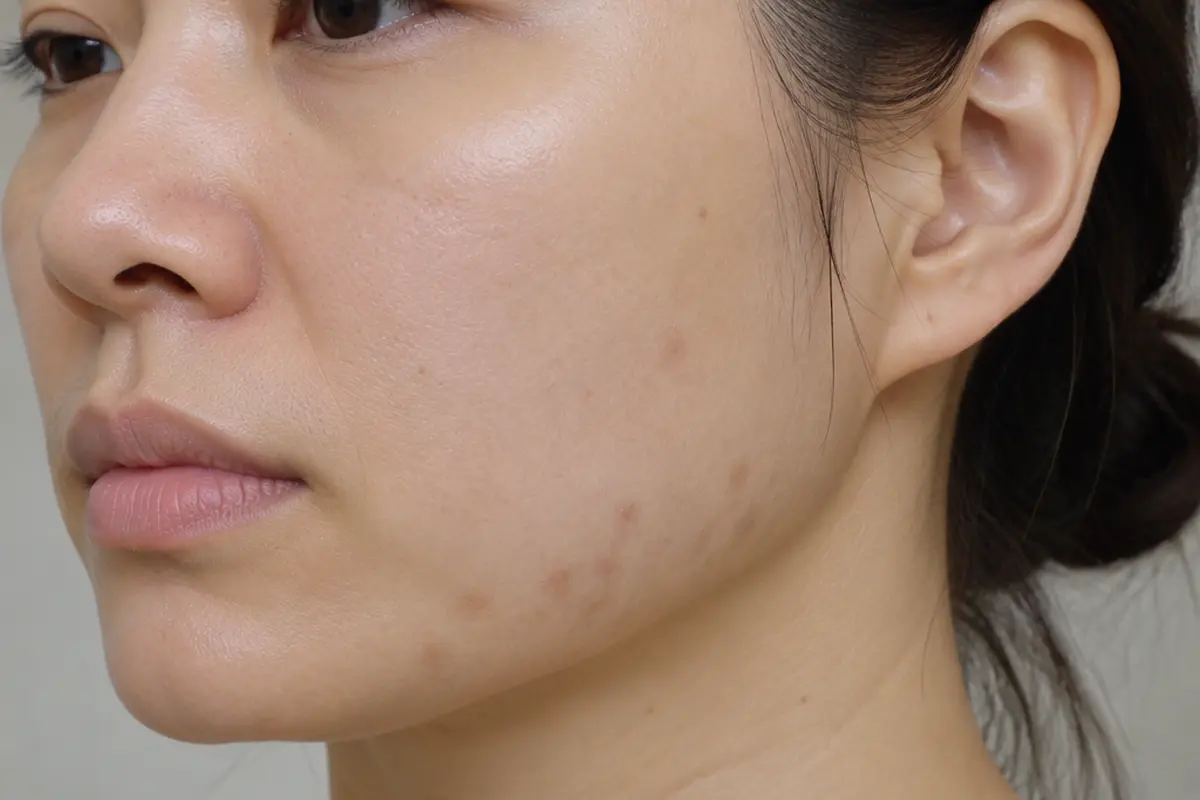
Marks left after inflammation fade slowly and can darken with sun. Illustrative image, not a patient.
That is why melasma is diagnosed before any device is used, and why laser, where it is used at all, sits inside a longer plan built on sun protection and topical care rather than replacing it. Aggressive settings can make melasma darker. How Dr Sin Yong approaches it, including R2 Glow where inflammation keeps producing pigment, is on melasma treatment, and the difference between melasma and sun spots on melasma vs sun spots.
“Pico laser is a good tool for the right pigment. The myth is that it is a good tool for every pigment.”
Dr Sin YongOn what pico laser can and cannot do
Myth 3: "Pico is always better than Q-switched laser"
Pico is not always better than Q-switched laser; the randomised evidence in Asian skin is mixed. A 2018 randomised trial in 30 Asian patients treated paired sun spots once with either a 532 nm nanosecond Q-switched laser or a 532 nm picosecond laser and found no significant difference in pigment clearance, whether judged by a blinded physician or by patients, although patients rated the picosecond side more satisfying. A 2020 split-face randomised study of 14 Asian patients with sun spots or acquired bilateral naevus of Ota-like macules (Hori's naevus) found more improvement and less discomfort on the picosecond side, with no difference in side effects or healing time.
Both trials were small, and they disagree, which is the honest answer. The pulse width is one variable among several; the wavelength, the energy, the mode and the pigment being treated matter as much. The comparison is set out in full on pico vs Q-switched laser.
Myth 4: "Pico laser can't cause dark marks in Asian skin"
Pico laser can still cause dark marks in Asian skin, though small series suggest the risk is lower than with older lasers. A 2016 retrospective analysis of 13 Chinese patients treated with a 755 nm picosecond laser for benign pigmented lesions recorded no post-inflammatory hyperpigmentation and transient lightening in two, against a risk of up to a quarter reported with Q-switched lasers in Asians. Thirteen patients is too few to call the risk absent.
Post-inflammatory hyperpigmentation is the darkening that follows injury, and Fitzpatrick III to V skin makes it readily. A 2013 focused review of acne- and procedure-related post-inflammatory hyperpigmentation in Asians described it as an integral part of the skin's response to inflammation, said prevention comes first, and warned that treatments used for it can themselves make it worse. In practice the usual causes after pico laser are energy too high for the skin, treatment repeated too soon, sun on freshly treated skin, and melasma treated as if it were a sun spot. Why Asian skin darkens, and how it is prevented, is on pico laser and PIH risk in Asian skin.
Myth 5: "Laser toning every week is harmless"
Frequent, open-ended laser toning is not automatically harmless, because energy accumulates. Most of the evidence comes from low-fluence Q-switched 1064 nm toning, the technique pico toning grew from. A 2022 systematic review of 42 studies of low-fluence Q-switched Nd:YAG for melasma found it generally effective and safe when compared with older treatments, but noted that mottled pale patches occasionally developed and persisted, possibly linked to high accumulated laser energy, and that even low-fluence toning can cause darkening through unwanted inflammation when used aggressively, especially in darker skin.
So the question is not how often a clinic can fit you in, but whether the skin has settled and responded before the next pass. Toning here is planned with review between visits, at conservative settings for skin that darkens easily, and stopped when it is not helping. This site does not publish a number of sessions, because the number follows the pigment and the response; what changes it is explained on laser toning.
Myth 6: "All pico lasers are the same"
Pico lasers differ in wavelength, mode and the evidence behind each use. Picosecond platforms emit at different wavelengths, such as 532, 755, 785 and 1064 nm, and offer spot, toning or fractional delivery. A 2021 systematic review of 77 studies graded the evidence by indication: level I for tattoo removal, level I to IV for benign pigmented lesions, and level II for melasma and for rejuvenation. The word pico on a menu tells you the pulse width and little else.
Dr Sin Yong uses the DEKA TORO, run as his T2 Frax Radiance protocol. Its picosecond emission is at 785 nm, and the same system carries 532 nm and 1064 nm nanosecond emissions. The wavelength follows where the pigment sits: 532 nm for superficial sun spots and freckles, 1064 nm for deeper pigment and darker skin, where it is the more conservative choice. Which device and mode suit which skin is set out on which pico suits you and, for the platform itself, on T2 Frax Radiance. Ask any clinic which wavelength it proposes for your pigment, and why.
Your next step
1. MessageWhatsApp +65 8023 7170 with what is bothering you. A reply comes from the clinic, not a bot.
2. AssessmentDr Sin Yong examines you himself on Orchard Road, with ultrasound where earlier filler is involved.
3. A plan in writingWhat he would do, what he would not, the fee factors, and the option of no treatment.
Every treatment is performed by Dr Sin Yong personally. Singapore Medical Council registered · invited to share his clinical expertise internationally for CLASSYS, DEKA, Fotona, Hironic and Ilooda.
Bring photographs of how your pigment has changed over time and a list of the creams you use. How consultations work.
No clinical study shows that pico laser thins the skin. A 2025 study in miniature pigs found the dermis thicker after 755 nm picosecond laser, though animal skin is not a human face. What harms skin is energy too high for the skin type or treatment repeated too soon, which is a question of settings, not of the device itself.
No. Pico laser does not touch the hormonal, light and vascular drivers of melasma. In a 2024 randomised split-face trial, ten of seventeen patients reported recurrence or worsening two years after pico or Q-switched laser. Laser, if used, sits inside a longer plan built on sun protection and topical care, at conservative settings, because aggressive treatment can darken melasma.
Not always. A 2018 randomised trial in Asian skin found no difference in clearing sun spots between picosecond and Q-switched 532 nm lasers, while a 2020 split-face study favoured pico for sun spots and Hori's naevus. Both were small. Wavelength, energy, mode and the pigment being treated matter as much as pulse width.
Yes, it can. Darkening after laser, called post-inflammatory hyperpigmentation, is a recognised risk in Asian skin. Small pico series report it less often than with older lasers, but not never. The usual causes are energy too high for the skin, treatment repeated too soon, sun on freshly treated skin, and melasma treated as a sun spot.
There is no safe fixed interval that suits everyone. A 2022 systematic review of low-fluence laser toning linked persistent pale patches to high accumulated energy and noted that aggressive toning can darken skin. Toning is spaced so the skin has settled before the next pass, reviewed against the response, and stopped when it is not helping.
No. Picosecond lasers differ in wavelength, such as 532, 755, 785 and 1064 nm, and in spot, toning and fractional modes, and a 2021 systematic review found the strength of evidence varies by indication. Dr Sin Yong uses the DEKA TORO, with 785 nm picosecond and 532 and 1064 nm nanosecond emissions chosen by where the pigment sits.
Pico laser can be used in Asian skin when the pigment is diagnosed first and the settings suit a skin that darkens easily. The main risks are post-inflammatory hyperpigmentation and, with melasma, rebound darkening. Sun protection before and after, conservative energy, spacing between treatments and review are what reduce those risks.
References
Clinical and histologic changes after 755-nm picosecond laser with a novel platinum focus lens array in the treatment of photo-aged skin. Lasers in Medical Science (Zhao S, Wang M, Shi C, et al.), 2025. source
Comparison of 755-nm picosecond alexandrite laser versus 1064-nm Q-switched Nd:YAG laser for melasma: A randomized, split-face controlled, 2-year follow-up study. Lasers in Surgery and Medicine (Zhou Y, Li Y, Hamblin MR, Wen X), 2024. source
Q-switched double frequency Nd:YAG 532-nm nanosecond laser vs. double frequency Nd:YAG 532-nm picosecond laser for the treatment of solar lentigines in Asians. Lasers in Medical Science (Vachiramon V, Iamsumang W, Triyangkulsri K), 2018. source
A Prospective, Split-Face, Randomized Study Comparing Picosecond to Q-Switched Nd: YAG Laser for Treatment of Epidermal and Dermal Pigmented Lesions in Asians. Dermatologic Surgery (Ungaksornpairote C, Manuskiatti W, Junsuwan N, Wanitphakdeedecha R), 2020. source
A retrospective analysis on the management of pigmented lesions using a picosecond 755-nm alexandrite laser in Asians. Lasers in Surgery and Medicine (Chan JC, Shek SY, Kono T, et al.), 2016. source
A focused review on acne-induced and aesthetic procedure-related postinflammatory hyperpigmentation in Asians. Journal of the European Academy of Dermatology and Venereology (Eimpunth S, Wanitphadeedecha R, Manuskiatti W), 2013. source
The Low-Fluence Q-Switched Nd:YAG Laser Treatment for Melasma: A Systematic Review. Medicina (Lee YS, Lee YJ, Lee JM, et al.), 2022. source
A Systematic Review of Picosecond Laser in Dermatology: Evidence and Recommendations. Lasers in Surgery and Medicine (Wu DC, Goldman MP, Wat H, Chan HHL), 2021. source
About this page: written and medically reviewed by Dr Sin Yong, MBBS (NUS), MRCS (Edinburgh) · Last reviewed 6 November 2026 · Illustrative images only, not patients · Editorial policy