Published 22 October 2026 · Reviewed by Dr Sin Yong
R2T2 vs pico laser toning is a comparison of a single-target treatment with a two-part plan. Pico laser toning uses low-energy picosecond pulses on pigment that is already deposited in the skin. The R2T2 laser plan uses a picosecond pass for that deposit too, and adds R2 Glow, which is directed at the low-grade inflammation and background redness that keep producing pigment.
Short answerPico toning treats the deposit. R2T2 treats the deposit and its driver. If the brown marks sit on calm skin, pico toning on its own may be all that is considered. If they sit on a reddish, reactive background, which is common in Singapore's sun, R2T2 plans both. Melasma is assessed separately in either case.
Low-fluence picosecond pulses that fragment melanin by a pressure effect with little heat spread; here it is delivered as T2 Frax Radiance on the DEKA TORO (785 nm picosecond, with 532 and 1064 nm nanosecond emissions)
R2T2
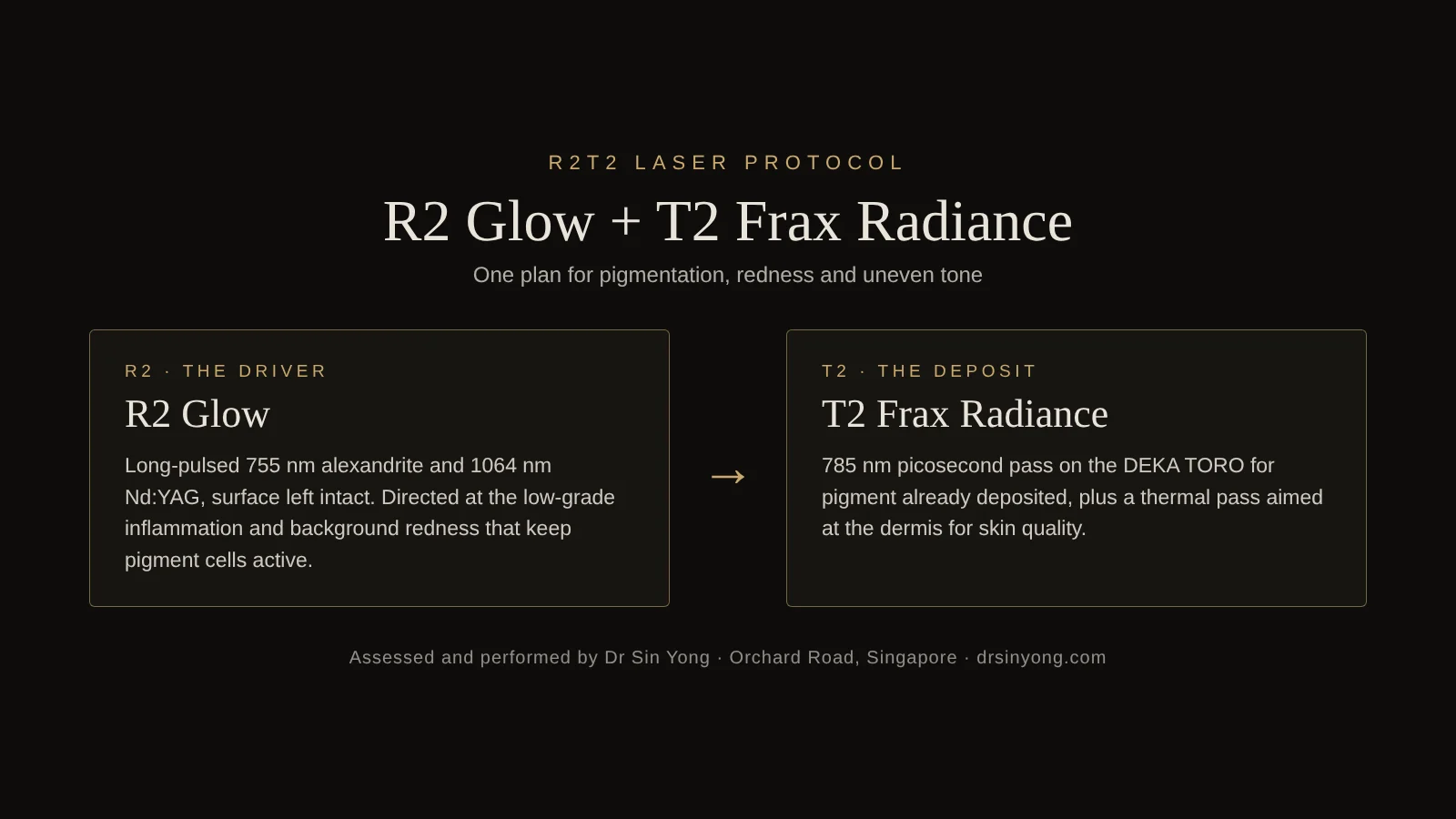
Dr Sin Yong's two-laser plan: R2 Glow (long-pulsed 755 nm alexandrite and 1064 nm Nd:YAG, surface intact) for inflammation and redness, with T2 Frax Radiance for the deposit and a thermal pass aimed at the dermis
What each acts on
Pico toning: the pigment already present. R2T2: the pigment and the inflammatory background that keeps pigment cells active
Typical fit
Pico toning: sun spots, freckles or uneven tone on calm skin. R2T2: dull, uneven tone with a reddish, reactive background
Melasma
Neither is a first step; diagnosis first, usually R2 Glow alone or no laser, with picosecond toning added conservatively once stable
What is the difference between R2T2 and pico laser toning?
A brown mark has two parts: the pigment already sitting in the skin, and whatever keeps pigment cells producing more. Pico laser toning is directed at the first. R2T2 is directed at both.
Pico laser toning
R2T2 laser (R2 Glow + T2 Frax Radiance)
Target
Deposited melanin
Deposited melanin, plus low-grade inflammation and background redness
Lasers
Picosecond (here 785 nm on the DEKA TORO)
Long-pulsed 755 nm and 1064 nm (R2 Glow), then 785 nm picosecond with a thermal pass (T2 Frax Radiance)
Surface
Intact
Intact
Typical fit
Sun spots, freckles, uneven tone on calm skin
Dull, uneven, reddish tone; skin that darkens easily
Order
Single protocol
R2 first when the skin is reactive; one session or staged, decided at consultation
Used at this practice
Yes, as T2 Frax Radiance
Yes, R2T2
The two are not rivals so much as steps. On many faces, R2T2 is simply pico toning with the inflammatory background treated as well, in the order the skin can tolerate.
When is pico laser toning on its own enough?
When the pigment is a fixed deposit on calm skin, such as sun spots or freckles without a red, reactive background, the driver is less of a factor and a picosecond protocol alone is what is usually discussed. The pico laser Singapore guide covers which spots respond to picosecond energy and which do not, and the T2 Frax Radiance page sets out the protocol used here.
When does R2T2 make more sense?
When brown marks sit on skin that is also reddish, flushes easily or darkens after sun, heat or earlier treatment. In Singapore much of that background inflammation is driven by daily ultraviolet exposure. Treating only the deposit in that setting leaves the process that produces pigment in place, so R2 Glow is planned alongside it, usually first when the skin is reactive. R2 Glow has its own page for skin where the inflammatory side is the main concern.
What about melasma?
Melasma is hormonal, chronic and heat-sensitive, and both picosecond toning and long-pulsed lasers deposit some heat. That is why melasma treatment in Singapore starts with diagnosis, sun protection and topical care. If a laser is used, it usually begins with R2 Glow alone at conservative settings, with picosecond toning added only once the skin is stable.
What decides the plan
Which brown it is: melasma, sun spot, freckle, Hori's naevus or a post-inflammatory mark, confirmed on examination.
Whether the background is red and reactive, which brings R2 Glow in.
Fitzpatrick type and any history of darkening after treatment or sun.
Recent sun exposure, isotretinoin, pregnancy or hormonal change, which defer laser work.
Your next step
1. MessageWhatsApp +65 8023 7170 with what is bothering you. A reply comes from the clinic, not a bot.
2. AssessmentDr Sin Yong examines you himself on Orchard Road, with ultrasound where earlier filler is involved.
3. A plan in writingWhat he would do, what he would not, the fee factors, and the option of no treatment.
Every treatment is performed by Dr Sin Yong personally. Singapore Medical Council registered · invited to share his clinical expertise internationally for CLASSYS, DEKA, Fotona, Hironic and Ilooda.
Arrive without make-up and with any earlier laser records; the pigment is identified before a wavelength is chosen. How consultations work.
Partly. The T2 half of R2T2, T2 Frax Radiance, uses a 785 nm picosecond pass on the DEKA TORO. The R2 half, R2 Glow, is a long-pulsed 755 nm and 1064 nm protocol, not a picosecond laser. R2T2 is the plan that combines them.
Not in the sense of more energy. The difference is what each one is aimed at: pico toning at deposited pigment, R2T2 at the deposit and the inflammation behind it. Settings in both are set for the skin type and tested before a full pass.
Yes, if an examination shows a reddish, reactive background as well as brown marks. Earlier laser records help, because they show what the skin has already tolerated. If pigment darkened after earlier treatment, that is assessed first.
Both usually leave transient redness, and a faint frosting can appear over a darker spot after a picosecond pass. How long it lasts varies with the setting and the person and is discussed at assessment rather than promised.
Neither is a first step. Melasma is heat-sensitive, so it is diagnosed first and usually begins with sun protection and topical care, with R2 Glow alone if a laser is used. Pico toning is added only conservatively once the skin is stable.
References
Torbeck RL, Schilling L, Khorasani H, Dover JS, Arndt KA, Saedi N. Evolution of the picosecond laser: a review of literature. Dermatol Surg. 2019;45(2):183-194. doi:10.1097/DSS.0000000000001697. source
Chan JC, Shek SY, Kono T, Yeung CK, Chan HH. A retrospective analysis on the management of pigmented lesions using a picosecond 755-nm alexandrite laser in Asians. Lasers Surg Med. 2016;48(1):23-29. doi:10.1002/lsm.22443. source
Tanghetti EA. The histology of skin treated with a picosecond alexandrite laser and a fractional lens array. Lasers Surg Med. 2016;48(7):646-652. doi:10.1002/lsm.22540. source
Mese Say E, Okan G, Gökdemir G. Treatment outcomes of long-pulsed Nd:YAG laser for two different subtypes of rosacea (n=66). J Clin Aesthet Dermatol. 2015;8(9):16-20. source
Syder NC, Chen A, Elbuluk N. Radiofrequency and radiofrequency microneedling in skin of color: a review of usage, safety, and efficacy. Dermatol Surg. 2023;49:489. doi:10.1097/DSS.0000000000003733. source
About this page: written and medically reviewed by Dr Sin Yong, MBBS (NUS), MRCS (Edinburgh) · Last reviewed 22 October 2026 · Illustrative images only, not patients · Editorial policy