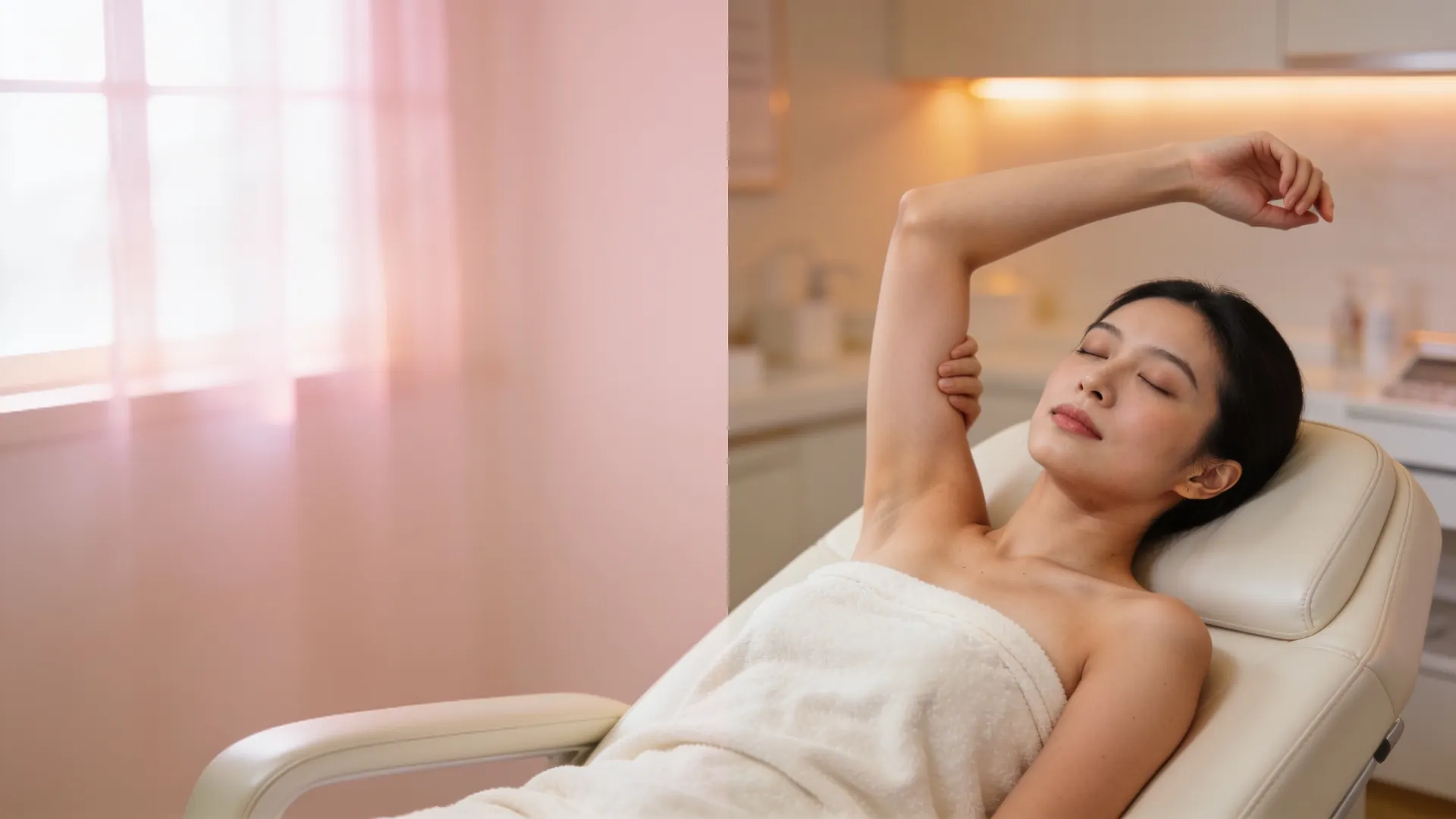
Why do underarms stay dark even after whitening creams?
Because the pigment is usually the end of a chain, not the start of it. Underarm hair and the shaving it needs, and sweat with the friction and deodorant that come with it, keep irritating the fold, and irritated skin keeps making pigment. Underarm whitening works when all three are targeted: the hair, the sweat and the pigment.
How does Dr Sin Yong treat dark underarms?
He examines the fold, then targets each driver: laser hair removal for the hair, a routine for sweat and deodorant (with heavy sweating assessed on its own), and his R2T2 laser plan for the pigment. Underarm whitening is from $288 per session.
Underarm whitening laser in Singapore lightens excess pigment in dark underarms. At this practice it is planned around three things that keep the underarm dark: the hair, the sweat and the pigment itself. Dr Sin Yong examines the fold, finds which of the three is driving the colour, and targets each one, so the skin is not simply lasered while the cause carries on.
Short answerDark underarms are usually post-inflammatory pigment from shaving, friction and irritant products, plus the grey shadow of coarse hair under the skin. Hair is reduced with doctor-performed laser hair removal, sweat and deodorant irritation are brought under control, and the pigment is treated with the R2T2 laser plan at cautious settings. Several sessions over two to three months is usual, from $288 per session.
Most people who ask about underarm whitening have already tried a cream, a scrub or a new deodorant. The colour faded a little and came back. That pattern has a simple explanation: the pigment was treated and its causes were left alone. In the underarm there are three, and they feed each other.
Driver 1
Hair
Coarse hair under the skin casts a grey shadow. Shaving and plucking scrape and inflame the fold, and ingrown hairs leave dark marks.
Targeted with laser hair removal, so there is less hair and less shaving
Driver 2
Sweat
A warm, damp fold rubs more. More sweat means more wiping and more deodorant, and irritant products sting skin that is already sore.
Targeted with a deodorant and friction routine; heavy sweating is assessed and treated as its own concern
Driver 3
Pigment
Irritated skin makes extra melanin. This post-inflammatory pigment is the brown colour that stays after the irritation has gone.
Targeted with the R2T2 laser plan, at cautious settings for the fold
Treat only the third and the first two rebuild it. That is why this plan has three targets instead of one, and why the examination comes before any laser.
How underarm hair darkens the underarm
Hair affects the colour of the underarm in two separate ways. The first is optical. Underarm hair is coarse and dark, and after shaving the hair shaft still sits just beneath the surface. Through thin skin it shows as a grey tinge that reads as pigment, even on lighter skin. No cream changes this, because it is not pigment.
The second is injury. Shaving daily, shaving dry, plucking and waxing all cause small, repeated injuries to the fold, and ingrown hairs add inflamed bumps. In Fitzpatrick III to V skin, which is most skin in Singapore, inflammation is answered with pigment. The darkening is better thought of as a record of years of small insults to the skin.
How it is targeted.Underarm laser hair removal heats the hair in the follicle so regrowth becomes sparse and fine. There is less hair to cast a shadow, and much less shaving. Dr Sin Yong chooses the wavelength for the fold itself: for darker underarm skin a 1064 nm setting is used to protect the skin. Hair removal does not remove pigment that has already formed, which is why it is one part of the plan and not the whole of it. Underarm laser hair removal here is from $288 per session.
Illustrative image — not a patient.
How sweat keeps the underarm dark
Sweat does not stain skin. What it does is keep the fold warm and damp, and damp skin rubs harder against itself and against sleeves. In Singapore's heat that friction is there most of the day. Friction is one of the recognised causes of underarm darkening, and washing or scrubbing harder to feel clean adds more of it.
Sweat also changes what people put on the skin. More sweat means more wiping and more deodorant or antiperspirant, applied more often, frequently straight after shaving. Fragranced and alcohol-based products sting on freshly shaved skin, and a product that stings is irritating it. The irritation is quiet, repeated, and answered with pigment.
How it is targeted. The routine is reset first: an unscented product applied to dry skin, looser breathable clothing, and drying the fold well after exercise. Any product that stings is stopped. Where sweating is heavy enough to soak clothing or to need constant reapplication, it is assessed as excessive sweating (hyperhidrosis) and treated as its own concern, because an underarm that is drenched all day will keep rubbing however carefully the pigment is treated. Smell, as opposed to wetness, is covered under body odour.
The pigment itself, and the laser plan for it
Once hair and sweat are under control, the pigment that is already in the skin can be treated without being rebuilt. Dr Sin Yong uses his R2T2 laser plan for the underarm. It splits the job in two.
R2 GlowA long-pulsed 755 nm and 1064 nm protocol directed at the low-grade inflammation that keeps producing pigment.
T2 Frax RadianceA 785 nm picosecond pass directed at the pigment deposit itself.
ReviewThe skin's response is read before the next step. No fixed number of sessions is sold in advance.
Splitting the work this way lowers the risk of rebound darkening in Asian skin. Settings are deliberately cautious: underarm skin is thin, warm and subject to friction, and over-treating it can cause the very darkening the treatment is meant to address. Where the skin is reactive, R2 Glow runs first over a few visits and T2 is added once the skin is calmer. Supervised topical agents that slow pigment production may be used alongside.
Table: The pigment itself, and the laser plan for it
What Dr Sin Yong finds
What is driving it
What is targeted first
Grey tinge that is worse just after shaving
Hair shadow under thin skin
Laser hair removal
Flat brown colour with bumps or ingrown hairs
Shaving and plucking injury
Laser hair removal, then R2T2 for the pigment
Brown colour with stinging, itching or a damp fold
Sweat, friction and product irritation
Routine reset, sweating assessed, then R2T2
Flat brown colour on calm skin
Pigment left from earlier irritation
R2T2 laser plan
Velvety, thickened or ridged darkening
Possible acanthosis nigricans
Medical check before any cosmetic plan
Illustrative image — not a patient.
How the plan runs, step by step
1. Examination. Dr Sin Yong asks how you remove underarm hair, which deodorants and creams you use, whether the darkening began after a change of product, and about weight or blood sugar concerns. Then he looks at and feels the skin. Flat, smooth darkening points to post-inflammatory pigment. A velvety surface is checked medically first.
2. Stop the irritation. A sharp blade with a lubricating gel, shaving in the direction of hair growth, an unscented product and drying the fold well. Without this step the pigment tends to return.
3. Target the hair. Laser hair removal is staged across visits, because only follicles in their growth phase respond at any one time.
4. Target the pigment. R2T2 sessions follow, spaced so the skin's response can be read before the next one.
5. Review. The usual course is several sessions over two to three months. Expect warmth and mild redness after a session. Keep the fold cool and dry for the rest of the day, avoid tight sleeves rubbing on it, and leave deodorant off until the skin has settled.
What the published evidence says
The research on underarm darkening is thinner than the marketing suggests. A 2025 systematic review of axillary hyperpigmentation found only ten studies and no standard treatment; several creams reduced pigment to varying degrees. Low-fluence 1064 nm Nd:YAG laser has been studied for post-inflammatory pigment in the underarm, including in women with Fitzpatrick IV to V skin, and a 2023 review of lasers for post-inflammatory hyperpigmentation in darker skin stresses conservative settings because the treatment can itself cause pigment. That is the reasoning behind treating the causes first and keeping the laser settings cautious. The papers are listed under References.
Who it suits, and who should wait
This plan suits flat brown or grey underarm darkening from shaving, friction, sweat and product irritation, in someone prepared to change the routine that caused it. It is deferred in pregnancy and while breastfeeding. Velvety, thickened darkening is acanthosis nigricans until shown otherwise and is checked medically before any cosmetic plan. An active rash, infection or broken skin in the fold is treated first.
The risks are redness, temporary darkening or lightening of the treated skin and, uncommonly, a blister or burn. Darker skin carries a higher risk of pigment change, which is why settings are conservative. Response varies between people, and some pigment is slow or incomplete to clear. Dr Sin Yong explains the options at the assessment, including no treatment.
Underarm whitening price
From $288 per session
Underarm whitening from $288 per session · Underarm laser hair removal from $288 per session The fee for your plan is confirmed in writing after the assessment.
What decides the fee is which of the three drivers need treating, the size of the area and how many sessions the examination suggests. More on fees is on underarm whitening Singapore.
Yes, in two ways. Coarse hair sitting just beneath freshly shaved skin gives a grey shadow that reads as pigment, even on lighter skin. And the way hair is removed matters: repeated shaving and plucking irritate the fold and cause ingrown hairs, and that irritation leaves post-inflammatory pigment behind. Laser hair removal thins the hair so there is less shadow and less shaving, but it does not remove pigment that has already formed, which is why pigment is targeted separately.
Sweat does not stain the skin, but it keeps the problem going. A warm, damp fold rubs more against skin and clothing, sweat makes people wipe and reapply deodorant or antiperspirant more often, and fragranced or alcohol-based products irritate skin that is already sore from shaving. Friction and irritation are what trigger the extra pigment. Managing sweat and the products used on the fold is part of the plan, and heavy sweating is assessed as its own concern.
Dr Sin Yong uses his R2T2 plan on the underarm. R2 Glow, a long-pulsed 755 nm and 1064 nm protocol, is directed at the low-grade inflammation that keeps producing pigment. T2 Frax Radiance adds a 785 nm picosecond pass for the pigment deposit itself. Settings are deliberately cautious, because underarm skin is thin, warm and subject to friction.
Several sessions, usually spread over two to three months, and the number is set after the fold has been examined. Flat brown pigment on normal-textured skin responds sooner than deeper grey pigment. The plan is reviewed as it goes; no fixed number is sold in advance.
Underarm whitening here is from $288 per session, and underarm laser hair removal is from $288 per session. The fee for your plan depends on which of the three drivers need treating, and it is confirmed in writing after the assessment.
They are planned together and often run in the same course, because less shaving removes one of the causes of the darkening. Whether both are done at one visit or staged depends on how irritated the skin is on the day. Dr Sin Yong performs both himself.
It can be, with the wavelength and energy chosen for the skin of the fold, which is usually a shade darker than the arm beside it. The main risk in darker skin is more pigment after treatment, so settings are conservative and the skin is reviewed before each step.
When the skin is velvety, thickened or slightly ridged, often with similar patches at the neck folds or with skin tags nearby. That pattern is acanthosis nigricans, which is linked to insulin resistance, and it is checked medically before any cosmetic plan.
Stop anything that stings or scrapes: dull blades, dry shaving, plucking, scrubs, and fragranced or alcohol-based deodorants. Bleaching creams from unregulated sources can contain undeclared ingredients that irritate or damage the skin. A sharp blade with a lubricating gel, an unscented product and drying the fold well after exercise are the simple changes that matter.
Peer-reviewed papers on this topic, listed for background reading. They report published research in general and are not a statement about results at this clinic.
Vahabi SM, Sajjadi S, Kalantari Y, et al. Axillary Hyperpigmentation Treatment: A Systematic Review of the Literature. J Cosmet Dermatol. 2025;24(8):e70418. PubMed 40843925 · DOI
Ghannam S, Al Otabi FK, Frank K, et al. Efficacy of Low-Fluence Nd:YAG 1064 nm Laser for the Treatment of Post-Inflammatory Hyperpigmentation in the Axillary Area. J Drugs Dermatol. 2017;16(11):1118-1123. PubMed 29141060
Robredo IGC. Q-Switched 1064nm Nd:YAG Laser in Treating Axillary Hyperpigmentation in Filipino Women With Skin Types IV-V. J Drugs Dermatol. 2020;19(1):66-69. PubMed 31985913 · DOI
Sowash M, Alster T. Review of Laser Treatments for Post-Inflammatory Hyperpigmentation in Skin of Color. Am J Clin Dermatol. 2023;24(3):381-396. PubMed 36781686 · DOI
Davis EC, Callender VD. Postinflammatory hyperpigmentation: a review of the epidemiology, clinical features, and treatment options in skin of color. J Clin Aesthet Dermatol. 2010;3(7):20-31. PubMed 20725554