Main guideDermal fillers in Singapore — what they treat, who they suit, the risks and how Dr Sin Yong approaches them.
Published 12 November 2026 · Reviewed by Dr Sin Yong
Piriform fossa filler is filler placed deep on the bone beside the nostril, in a pocket called the deep pyriform space. The aim is to support the top of the smile line from underneath instead of filling the crease directly. The area sits next to important blood vessels, so anatomy and technique matter more here than the product.
Short answerPiriform fossa filler places a small amount of filler on the bone beside the nostril, in the deep pyriform space, to support the upper nasolabial fold. It suits a fold deepened by a set-back area beside the nose, not one caused by a descending cheek. The angular artery runs close by, so blocked blood supply is the serious risk. Dr Sin Yong maps the area with ultrasound on Orchard Road, Singapore, before advising any filler; hyaluronic acid filler has the advantage that it can be dissolved.
The pyriform (or piriform) aperture is the pear-shaped opening in the skull for the nose. The bone around its lower outer edge thins and recedes with age, and in some faces it is naturally set back. The soft tissue beside the nostril then loses support, and the top of the smile line deepens.
Piriform fossa filler places a small amount of filler deep on that bone to restore the support. It is one way of treating the nasolabial fold, and differs from placing filler in or under the crease itself.
The deep pyriform space: the anatomy that matters
The deep pyriform space was described as a distinct pocket of the midface by Surek, Vargo and Lamb in 2016. It lies against the bone beside the nostril, bounded on the inner side by the depressor septi nasi muscle and on the outer side by the deep medial cheek fat and the muscles that lift the lip.
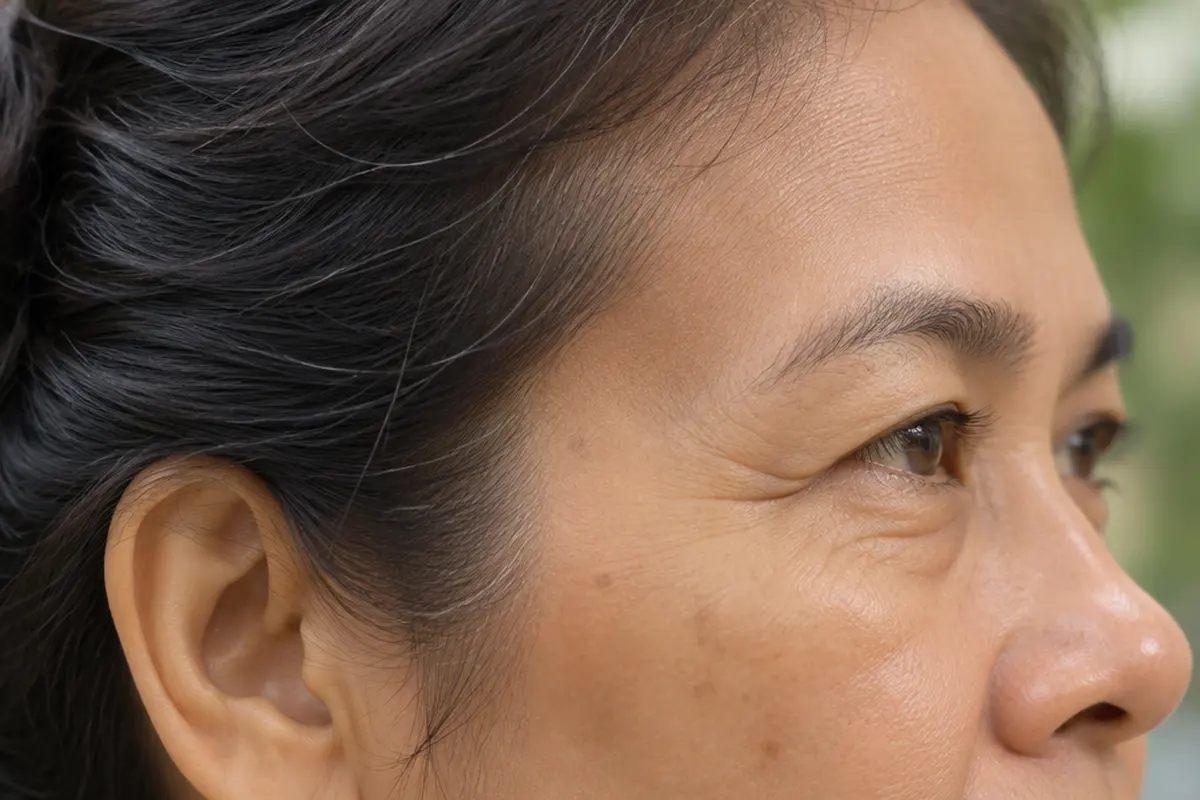
Temple hollowing changes how the upper face frames the eyes. Illustrative image, not a patient.
In that dissection study, the angular artery ran in the roof of the space, above the level of a deep injection placed on bone. A later study of 22 cadavers described a separate perialar space next to it and noted the infraorbital nerve running above the deep pyriform injection site (Yoon 2026).
These are findings from dissection, and arteries vary from person to person and from one side of a face to the other. The region around the nose remains one of the higher-risk areas of the face for filler.
Who does it suit, and who does it not?
It suits a fold that is deepest at the top, beside the nostril, in a face where that area is flat or set back. Pressing gently upwards on the tissue beside the nose and seeing the fold soften is a simple clue.
Swipe sideways to see the whole table.
What is causing the fold
Does piriform fossa filler fit?
What is considered instead
A set-back or hollow area beside the nostril
Yes, this is the indication
A cheek that has descended and folds over the line
Urgent: a change in vision or eye pain after an injection means calling 995 now. Skin that turns white, pale, dusky or mottled, or pain that is getting worse, needs the doctor who injected you, or A&E, now.
The serious risk is filler entering or compressing an artery. Beside the nose that can cut off the blood supply to the skin of the nostril and nose tip, and, rarely, filler can travel to the artery supplying the eye. Early signs are skin that turns pale, dusky or mottled, and pain out of proportion.
Other risks are bruising, swelling, lumps, a widened look to the base of the nose if too much is placed, numbness from pressure on the infraorbital nerve, and filler moving from where it was placed, which has been reported with deep pyriform injection (Yoon 2026). The warning signs of a blocked vessel are set out under vascular occlusion after filler.
Is it safer than filling the fold directly?
The argument for the deep pyriform space is that a deep injection on bone sits below the artery, whereas the artery often runs within or just under the fold itself. That is a reason the approach was proposed, not a guarantee. No filler placement beside the nose is without vascular risk.
What reduces risk is knowing where the vessels are in the individual face, using small amounts placed slowly, choosing a filler that can be dissolved, and having hyaluronidase to hand.
How Dr Sin Yong approaches the upper smile line
He examines the fold at rest and on smiling to see whether it comes from the area beside the nose, the cheek above it or the skin. He scans the area with ultrasound to see the vessels and any filler already there. Where filler is right for this area, hyaluronic acid has the advantage that it can be dissolved with hyaluronidase.
Where the fold comes from descent, he explains lifting options instead. He performs every injection himself on Orchard Road, Singapore, and the plan, including the option of no treatment, is given in writing. He also sees patients for filler complications from this area.
Your next step
Not for emergencies. A change in vision or eye pain after an injection: call 995 now. Pale, dusky or mottled skin, or pain that is getting worse: go now to the doctor who injected you, or to A&E. Do not message or book for these signs.
1. MessageWhatsApp the clinic with what is bothering you, and the product and date if you know them. A reply comes from the clinic, not a bot.
2. AssessmentDr Sin Yong examines you himself on Orchard Road, with an ultrasound scan of the area.
3. A plan in writingWhat he would do, what he would not, the fee factors, and the option of no treatment.
Every treatment is performed by Dr Sin Yong personally. Singapore Medical Council registered · invited to share his clinical expertise internationally for CLASSYS, DEKA, Fotona, Hironic and Ilooda.
The area beside the nose is examined and scanned with ultrasound before any filler is advised. How consultations work.
Piriform fossa filler is filler placed deep on the bone beside the nostril, in a pocket called the deep pyriform space. It supports the top of the nasolabial fold from underneath. It is also spelt pyriform fossa filler.
It carries the risks of any filler near the nose, including the rare but serious risk of blocked blood supply to the skin or the eye. A deep injection on bone is intended to sit below the angular artery, but arteries vary. Risk is reduced by ultrasound mapping, small amounts, a filler that can be dissolved and a doctor who can treat a complication at once.
It is a pocket of the midface against the bone beside the nostril, described by Surek and colleagues in 2016. It is bounded by the depressor septi nasi on the inner side and by the deep medial cheek fat and lip-lifting muscles on the outer side. The angular artery was found in its roof.
People whose smile line is deepest beside the nostril because that area is flat or set back. It does not suit a fold caused by a cheek that has descended, or a face that already has filler in the area that has not been mapped.
Hyaluronic acid filler can be dissolved with hyaluronidase, which is an advantage in a higher-risk area. Fillers that are not hyaluronic acid cannot be dissolved this way.
Yes. He maps the area with ultrasound first to see what is there and where it sits, then sets out the options in writing. He sees patients on Orchard Road, Singapore.
References
Surek CK, Vargo J, Lamb J. Deep Pyriform Space: Anatomical Clarifications and Clinical Implications.
Yoon SE, Choi JW, Nam YS, Kim IB. Targeting the Perialar Space for Enhanced Nasolabial Fold Rejuvenation: A Cadaveric Study. Journal of Cosmetic Dermatology, 2026. source
About this page: written and medically reviewed by Dr Sin Yong, MBBS (NUS), MRCS (Edinburgh) · Last reviewed 12 November 2026 · Illustrative images only, not patients · Editorial policy
Not for emergencies. A change in vision or eye pain after filler: call 995 now. Pale, dusky or mottled skin, or pain that is getting worse: go now to the doctor who injected you, or to A&E. Do not message or book for these signs.