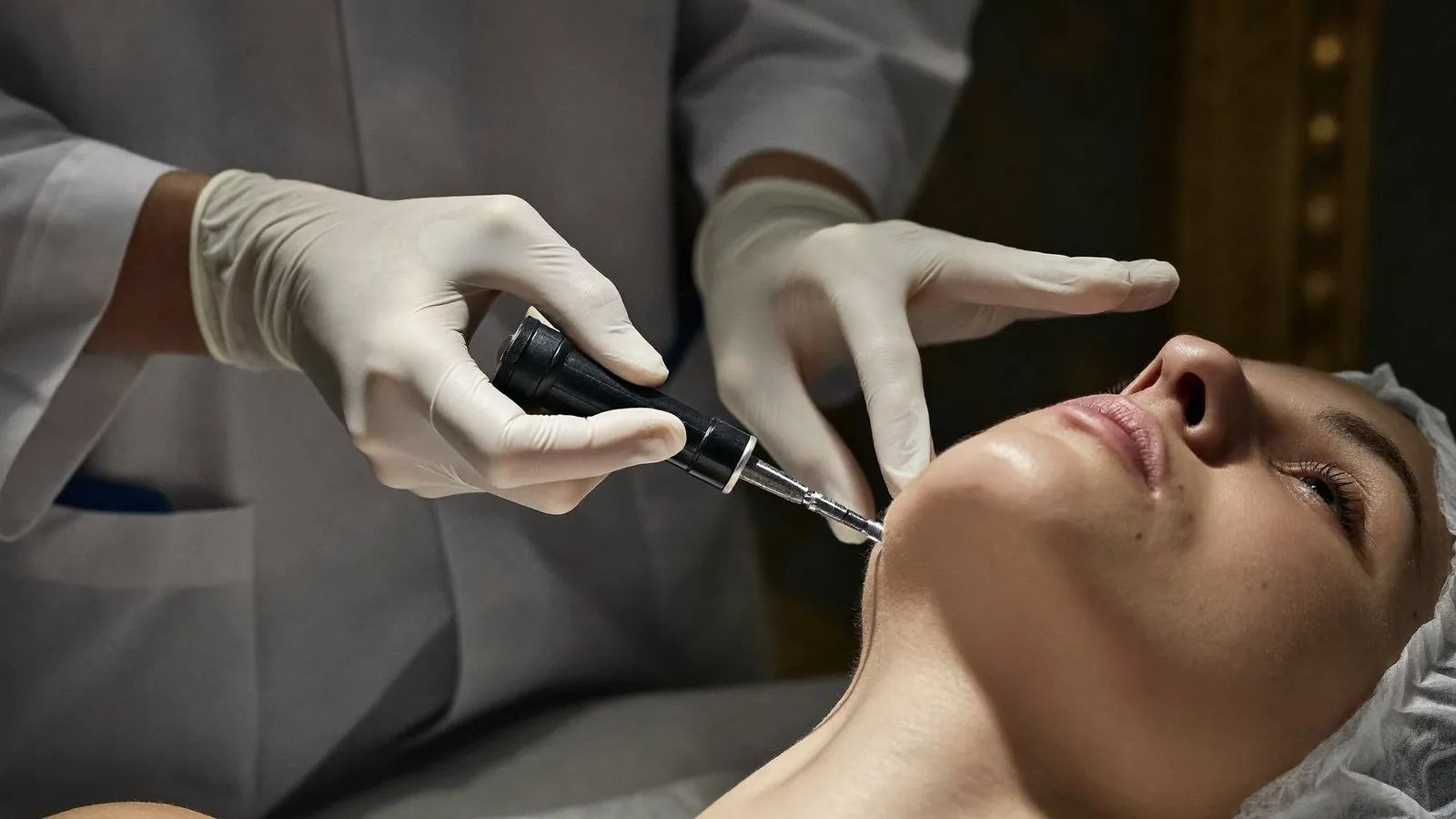
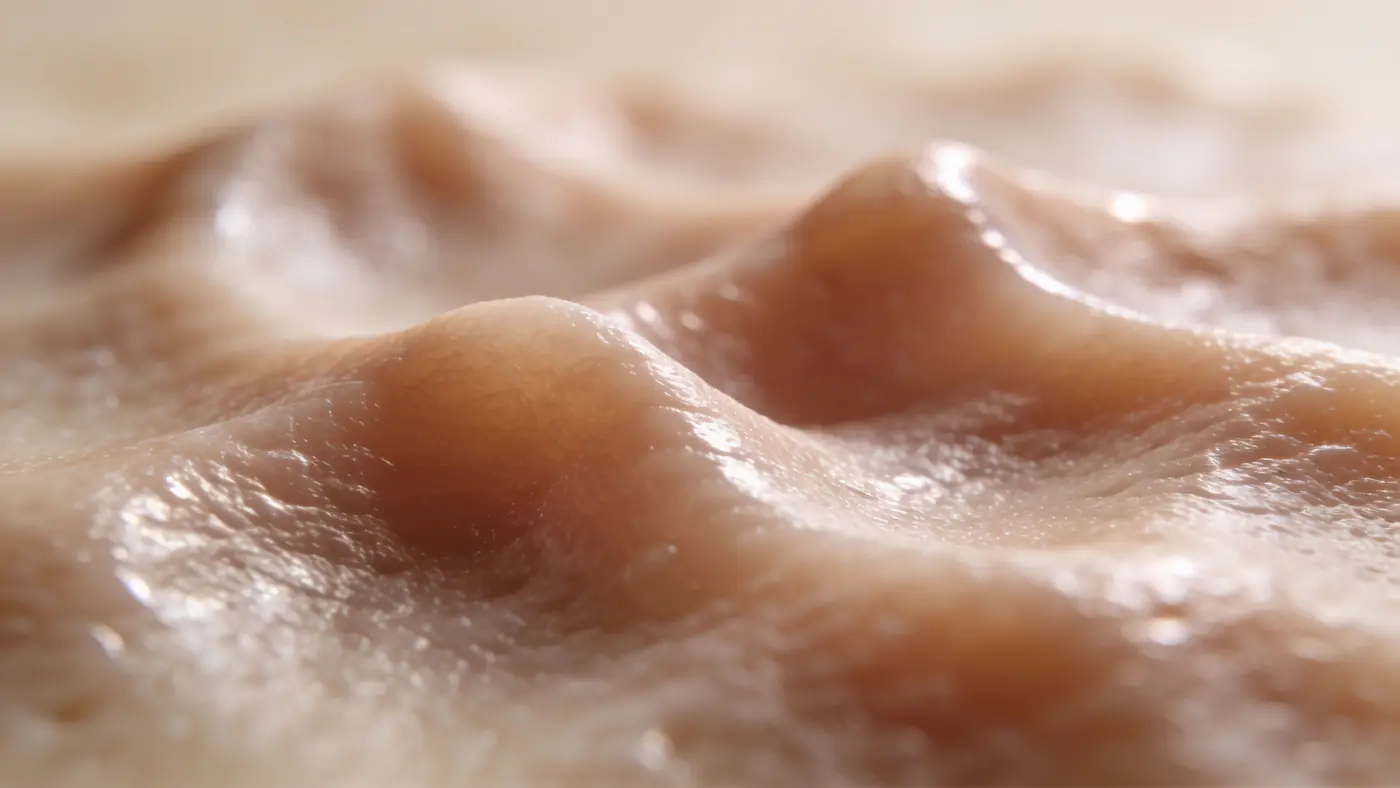
Subcision is a procedure for tethered acne scars: under local anaesthetic, a needle or blunt cannula is passed beneath the scar to divide the fibrous band holding it down, leaving the skin surface intact. It suits rolling and some boxcar scars that stay pinned when the skin is stretched, and is usually sequenced before resurfacing.
Key facts
- Tethered scar
- A depression anchored by fibrous bands running from the underside of the dermis to deeper tissue
- The mechanical problem
- The surface cannot sit level while the band below holds it down — like an upholstery button dimpling a cushion
- Subcision
- Subcutaneous incisionless surgery: a needle or cannula passed beneath the scar to divide the tether. Described by Orentreich & Orentreich, 1995
- Plane of work
- The subcutaneous plane, beneath the dermis — deeper than any resurfacing energy is intended to act
- The stretch test
- Skin stretched between two fingers: a surface scar flattens; a tethered scar stays pinned down
- Behaviour on animation
- Tethered scars deepen when the face moves — the band is pulled by the muscle beneath
- Sequencing
- Release before resurfacing, so surface remodelling happens on skin that is free to lie flat
- Skin types in Singapore
- Predominantly Fitzpatrick III–V — technique and aftercare planned around post-inflammatory pigment risk
The plateau nobody explains
Of all the scar patients I see, the largest single group is not people starting out. It is people who have already had treatment — often good treatment — and stalled.
The pattern is consistent. Resurfacing improved the overall texture: the shallow scars softened, the skin's finish evened out. But a handful of depressions survived every round unchanged, and eventually the improvement curve went flat. At that point most clinics offer more of the same, at higher energy. That is usually the wrong direction — more energy into a scar whose problem is not at the surface adds inflammation without addressing the cause, and in darker skin types inflammation has a cost of its own.
The scars that survive resurfacing are very often tethered — held down from below by fibrous bands that run from the underside of the dermis to deeper tissue. Resurfacing works on the surface, and the surface was never these scars' problem. The classification behind this, and the other scar types that share a cheek, is set out in my guide to acne scar types.
Understanding this one distinction explains most stalled scar journeys I see, which is why it deserves its own page.
What a tether actually is
When deep acne inflammation heals, it does not always heal cleanly in layers. Scar tissue can form as a vertical band — a cord of fibrous tissue anchoring the underside of the skin to the tissue beneath it.
The mechanics are the same as an upholstery button. The fabric of a cushion is smooth and intact; the dimple exists because a thread pulls it down from inside. You can steam, brush or replace the surface fabric indefinitely — the dimple returns, because its cause is the thread.
This is also why tethered scars behave distinctively. They deepen on animation, because the band transmits the pull of movement in the tissue beneath. And they resist flattening when the surrounding skin is stretched, because the anchor point does not move. Both behaviours are visible in an examination, and neither is visible in a photograph — one of several reasons scar plans made from photos go wrong.
Tethering is not confined to the classic rolling scar, either. A boxcar depression can be tethered at its base; so can a traumatic or surgical scar years after the original injury. The question is never what the scar is called. It is whether something below is holding it down.
“You can resurface a tethered scar indefinitely. The tether keeps pulling it down.”
Dr Sin YongOn why scar treatment plateaus
The stretch test you can do at home
You can get a first approximation of your own scar map with nothing but a mirror and two fingers.
Place a finger either side of a scar and stretch the skin gently apart. Watch the base of the depression. If the scar fades or flattens as the skin tightens, its problem is predominantly at the surface — the kind of scar resurfacing is designed for. If the base stays pinned down while everything around it stretches, something is holding it there, and that something is below the reach of any surface treatment.
Then smile broadly and watch again. A scar that becomes more obvious with animation is declaring its tether.
This is a screening observation, not a diagnosis — depth, direction and the number of bands still need proper examination. But if your stubborn scars fail the stretch test, you have your explanation for the plateau, and more surface energy is unlikely to change it.
What subcision does, and where it fits in the sequence
Subcision — subcutaneous incisionless surgery, described by Orentreich and Orentreich in 1995 — addresses the tether directly. A needle or blunt cannula is passed beneath the scar, in the subcutaneous plane, and the fibrous band is divided. The skin above is left intact; the work happens entirely below it.
Two things follow from the release. The mechanical downward pull is gone, so the surface is free to sit level. And the controlled injury beneath the scar triggers its own repair response — new collagen forming in the space where the band used to be, which helps support the released skin from below.
Sequence is the part most plans get wrong. Release comes before resurfacing, because resurfacing remodels skin in whatever position it finds it — resurfacing a still-tethered scar polishes a dimple that is being actively held down. Within my 4D Scar Reconstruction protocol, subcision is the foundation step: tethers first, then volume support where it is needed, then the scar walls and surface texture. Each stage prepares the ground for the next.
Not every scar needs subcision, and not every tethered scar needs everything else. Which scars qualify comes out of the assessment, scar by scar. In Fitzpatrick III to V skin — most of what I treat — the technique, the depth of work and the aftercare are also planned around pigment risk, because bruising and inflammation handled carelessly can leave their own marks.
Why this page has no before-and-after images
Subcision is a treatment people understandably want to see evidence for, so the absence of photographs deserves a direct answer.
Under Singapore's Healthcare Services Act, before-and-after imagery in advertising for licensable healthcare services is prohibited. There is no consent form or disclaimer that permits it, and after-only images fall under the same rule. The prohibition applies identically to every licensed clinic in Singapore — a site displaying such images is not demonstrating better results, only weaker compliance.
What can be shown is your own skin, in person, under directed lighting and stretch — which is the only examination that identifies a tether reliably anyway.
What determines the cost
Prices for licensable healthcare services cannot be advertised in Singapore, including as ranges or "from" figures. What the cost depends on can be stated plainly.
The factors are the area involved, what the assessment finds — how many scars are tethered, how dense and deep the bands are — whether subcision is performed alone or as one stage of a combined protocol, and how the plan is staged over time. Releasing three tethered scars on one cheek and rebuilding a decade of mixed scarring across a whole face are not comparable pieces of work.
Fees are set out in full at consultation, once your scars have actually been examined and there is something specific to cost.
The part worth saying first
If your scar treatment has plateaued, the likeliest explanation is not that you need a stronger laser. It is that some of your scars are tethered, and the tether has never been addressed. Release is the step that changes what every subsequent treatment can achieve — and it has to come first.
Dr Sin Yong — MBBS (NUS), MRCS (Edinburgh), MSc Aesthetic Medicine with Distinction (Queen Mary, London), MSc Practical Dermatology (Cardiff), and MRCS (Royal College of Surgeons of Edinburgh) — examines scars personally on Orchard Road, and will tell you plainly which of yours are tethered and which never were.