Key facts
- What they are
- Demodex folliculorum and Demodex brevis: eight-legged mites under half a millimetre long
- Where they live
- Hair follicles and their oil glands on the forehead, cheeks, sides of the nose, eyelashes and ears
- Who carries them
- A normal finding in most adults; rarely seen in children under five
- When they matter
- Demodicosis: mite density well above normal, commonly defined as more than five per square centimetre
- Rosacea link
- Mite numbers are higher in rosacea and likely add to the inflammation, but are not its sole cause
- Diagnosis
- Examination and history, dermoscopy and, where needed, a standardised skin surface biopsy
- Treatment aim
- Reduce overgrowth and inflammation; eradication is neither realistic nor necessary
What are face mites, and does everyone have them?
Face mites are two species of Demodex that live in human skin, and almost every adult carries them. Demodex folliculorum, around 0.3 to 0.4 mm long, lives in the hair follicles, including the eyelashes; Demodex brevis, roughly half that size, lives deeper, in the oil glands attached to those follicles. Both are close to invisible without a microscope.
They are rarely found in young children and become more common as oil production rises, which is why they concentrate on the oiliest parts of the face: the forehead, cheeks, sides of the nose, eyelids and external ears. They feed on skin cells and gland contents, are mostly active at night, and retreat into the follicle in bright light.
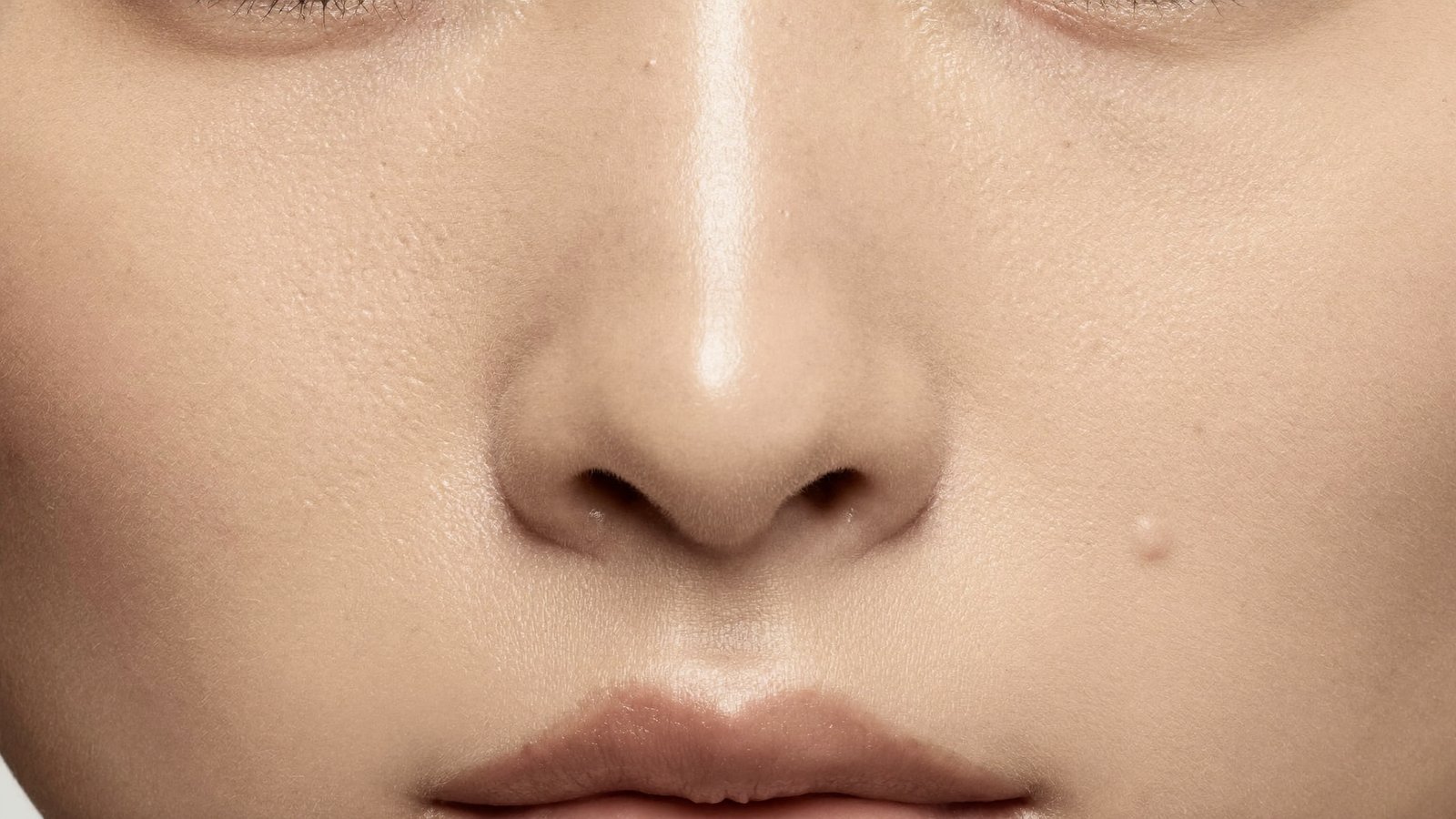
For most people, that is the whole story. A normal population of Demodex causes no symptoms, needs no treatment and is not a sign of poor hygiene. The useful question is never whether you have face mites, because the answer is almost certainly yes, but whether their numbers have outgrown what your skin tolerates. It is also why a magnified close-up online, or a single mite seen on a sample, says nothing on its own about whether treatment is needed.
When do face mites become a skin problem?
Face mites become a problem when they multiply well beyond their normal density, a condition called demodicosis. Diagnostic studies sample a measured area of skin and treat a count above roughly five mites per square centimetre as abnormal, although that number is a guide that sits alongside the clinical picture rather than replacing it.
Dermatologists describe two broad patterns. Primary demodicosis arises without another skin disease behind it: sometimes as fine, dry, sandpaper-like scale in the follicles with little visible inflammation, sometimes as inflamed papules and pustules, often around the mouth and eyes. Secondary demodicosis is associated with suppressed immunity, whether across the body or locally in the skin, and long use of steroid creams on the face is a recognised local cause.
What tips a normal population into overgrowth is not fully understood. Associations reported in the literature include increasing age, oily skin, heavy occlusive cosmetics and oil-based cleansers, a disturbed skin barrier and anything that dampens local immunity. None of these is a hygiene failing; each changes the follicular environment in a way that favours the mites, which is why the history matters as much as the count.
The eyelids are a separate territory. Demodex blepharitis causes itchy, irritated lid margins with crusting and waxy cuffs of debris at the base of the lashes, sometimes with lash loss. Because it involves the eye, it is assessed and managed with an eye specialist rather than treated as a facial skin problem alone.
“Rosacea is not sensitive skin that got worse. It is a different condition, and treating it as sensitivity is why people spend years switching cleansers while the inflammation continues underneath.”
Dr Sin YongOn the commonest misdiagnosis behind facial redness
Are face mites the cause of rosacea?
Not on their own, but they are part of the picture. Studies consistently find higher Demodex density in rosacea skin, particularly in the papulopustular form, and the mites and the bacteria associated with them likely participate in the inflammation. The foundation of rosacea, however, is the skin's own dysregulated immune and vascular response.
That distinction has practical weight. Reducing mite numbers can settle the inflammatory bumps in some patients, which is one reason a topical agent used in rosacea acts on Demodex as well as on inflammation. It does not close established visible vessels, stop flushing or remove the triggers, such as heat, sun, alcohol and spicy food, that keep persistent facial redness going.
The two also tend to look different at the edges. Rosacea is usually centred and roughly symmetrical, with flushing and a background of redness; demodicosis is more often itchy and scaly, with follicular bumps, and is sometimes one-sided. They overlap often enough that the question is usually how much of each is present rather than which one, and the answer shapes the rosacea treatment plan. In practice, a person with rosacea and a high mite count may need an antiparasitic element alongside the usual rosacea measures of sun protection, barrier care and trigger management, rather than one in place of the other.
How do doctors diagnose demodicosis?
Diagnosis starts with examination and history: where the bumps sit, whether there are comedones, how the skin feels, what has been applied to it, and whether steroid creams have been used. Itch, burning and fine follicular scale on a red background point towards demodicosis, while blackheads and whiteheads point towards acne.
Dermoscopy, a magnified examination of the skin surface, can show fine, spiky white structures protruding from follicle openings, which are the visible tails of mites. Where confirmation is needed, a standardised skin surface biopsy samples one square centimetre by pressing a slide with a drop of cyanoacrylate adhesive against the skin, so the mites lifted from the follicles can be counted under a microscope. Scrapings examined directly are an alternative.
Part of the work is excluding look-alikes. Acne has comedones; fungal folliculitis produces itchy, uniform bumps, often on the chest, back and forehead; perioral dermatitis clusters around the mouth with a clear rim at the lip; seborrhoeic dermatitis gives greasy, flaky redness in the brows and nose creases. Each is managed differently, so the label matters before anything is prescribed.
How is demodicosis treated, in principle?
Treatment aims to bring mite numbers back to normal and settle the inflammation; eradicating Demodex is neither possible nor necessary. The options below are described for education only. The prescription agents among them need a doctor's assessment, and the choice depends on the pattern, its severity, whether the eyelids are involved, pregnancy and any other conditions.
Topical agents with activity against mites are the usual starting point. They include ivermectin cream, which has been compared with metronidazole cream in a randomised trial in inflammatory rosacea, as well as permethrin, metronidazole and sulfur-based preparations. None of them is a quick fix, because the mite life cycle and the inflammation both take time to turn over. The published evidence for many of these agents is still limited, which is one more reason the plan is reviewed rather than fixed.
Oral treatment is reserved for extensive disease or for people with weakened immunity, and a tetracycline-class antibiotic may be used where rosacea inflammation is prominent; these are prescription medicines whose side effects and interactions are reviewed first. Eyelid involvement is managed with lid hygiene and products formulated for the lid margin, under an eye specialist's guidance. Pregnancy and breastfeeding change which options are appropriate, and should always be mentioned.
Where diffuse redness persists after the bumps have settled, a conservative laser approach directed at inflammatory activity in the skin, such as R2 Glow, can be considered within the plan. It is used after diagnosis, never instead of it, and it does not replace medical management.
What does not help with face mites?
Steroid creams are the trap to avoid. They blanch redness for a few days, then allow mites to multiply and the eruption to return more widely; steroid-related demodicosis and perioral dermatitis are both well described. Any facial steroid use should be mentioned at assessment, and stopping one is better done with medical guidance, because the skin often flares first.
Scrubbing harder does not reach mites living inside follicles and oil glands; it strips a barrier that, in rosacea and demodicosis, is already irritated. Layering acne products, such as benzoyl peroxide washes, strong acids or full-strength retinoids, onto a face that is actually mite-driven or rosacea-prone tends to sting and inflame rather than clear.
Neat tea tree oil, home remedies sold as mite killers and repeated antiseptic washes are common internet suggestions; they irritate easily, and a reaction can blur the diagnosis. Fresh pillowcases and clean make-up brushes are sensible hygiene, but face mites are normal residents of the skin rather than something picked up from bedding. A simpler routine, with a gentle non-soap cleanser and fewer heavy, oil-based products, supports treatment far more than any attempt to sterilise the face.