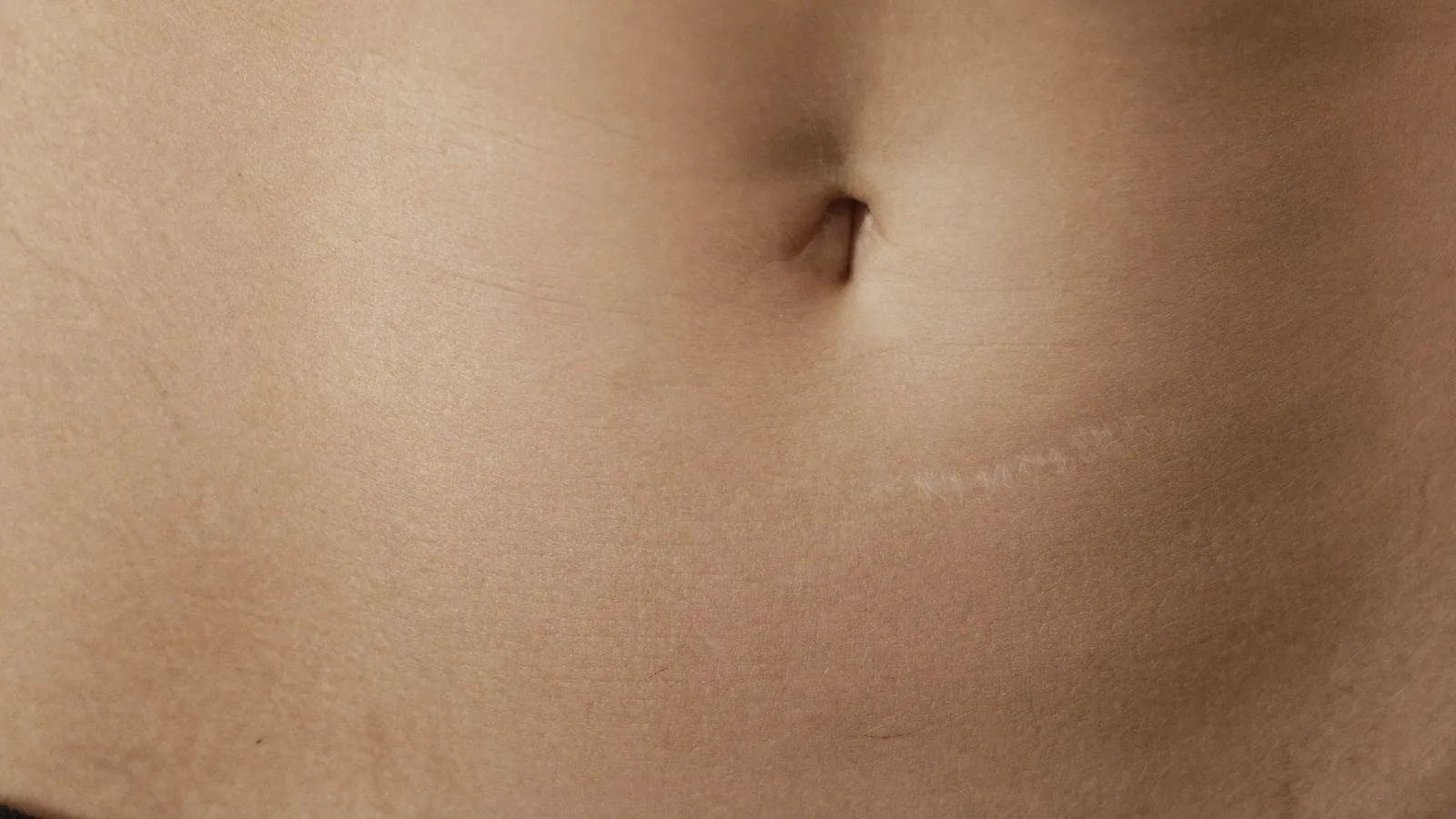
Scar revision timing matters because a surgical scar keeps remodelling for many months, sometimes beyond a year. An immature scar, still pink, vascular or raised, is more open to non-surgical influence than a pale, flat, mature one, so assessment starts by judging where the scar sits in its healing before choosing an approach.
Key facts
- Inflammation phase
- The first days after injury — clotting, immune clearance of debris, the signals that recruit repair cells
- Proliferation phase
- The following weeks — fibroblasts lay down a rapid scaffold of collagen and new blood vessels fill the wound
- Remodelling phase
- The longest phase — continuing for many months, sometimes beyond a year, as the scar reorganises
- Collagen conversion
- Early scar collagen is predominantly type III; over months it is progressively replaced by the stronger, more organised type I
- Immature scar
- Pink or red, vascular, often raised or firm — a scar still being actively rebuilt
- Mature scar
- Pale, flat, avascular — remodelling largely complete, the architecture set
- Hypertrophic scar
- Raised excess collagen that stays within the boundary of the original wound
- Keloid
- Scar tissue that grows beyond the original wound boundary — a distinct condition requiring its own approach
4D Scar ReconstructionThe sequenced acne-scar programme (subcision, filler support, TCA CROSS, S3 resurfacing) is on
4D Scar Reconstruction.
4D scar reconstruction for scars that have already matured
4D scar reconstruction is Dr Sin Yong's sequenced protocol for established, depressed scars, including surgical ones: subcision releases tethering, Radiesse supports the released space, TCA CROSS treats narrow tracts, and point-shot and fractional CO2 work resurfaces the surface. For a scar that has matured, each step is a deliberate reactivation rather than a nudge to a process already running, so tempo and expectations change. Early assessment keeps more options open.
The question nobody asks: when
People researching scar revision in Singapore compare devices, techniques and clinics at length. Almost nobody asks the question that shapes the outcome as much as any of those: where is the scar in its own biology?
A scar is not a finished object. From the day of surgery or injury it moves through a sequence of healing phases, and its responsiveness to treatment changes as it goes. The same technique applied to the same scar at different points in that sequence is, in a meaningful sense, a different treatment.
The conventional advice — wait until the scar has fully matured, then see what you are left with — made sense in an era when revision meant cutting the scar out and starting again. It makes far less sense now, when much of what is done works with the remodelling process rather than after it. Waiting out the most responsive window, then treating the least responsive tissue, is the standard sequence of events. It is also backwards.
How a wound actually heals
Wound repair runs in three overlapping phases, described in detail in the wound-healing literature (Gurtner and colleagues, Nature, 2008).
Inflammation comes first — the days immediately after injury, when the wound clots, immune cells clear debris and bacteria, and the chemical signals go out that summon the repair machinery. Proliferation follows over the subsequent weeks: fibroblasts lay down a rapid scaffold of collagen, new blood vessels grow into it, and the wound closes and fills. It is quick, and it is untidy — the priority is a sealed wound, not an elegant one.
Then comes remodelling, and this is the phase most people know nothing about. For many months — often well beyond a year — the scar is quietly reorganised. The hastily laid type III collagen is progressively broken down and replaced with the stronger, better-organised type I. Fibres realign along lines of tension. Excess vessels regress. The scar you see at a few weeks is not the scar you will have; it is a draft.
A tissue that is actively being demolished and rebuilt is a tissue whose behaviour can still be influenced. That is the entire argument for timing.
“Scar tissue is far more responsive while it is still remodelling. Timing matters as much as technique.”
Dr Sin YongOn the window most people wait out
Reading a scar's maturity
You can estimate where a scar sits in this sequence from across the room, because the signs are visible — and reading them is the first thing I do when a scar is brought to me, before any conversation about methods begins.
An immature scar is pink or red, because it is still full of the blood vessels that fed proliferation. It may feel firm, raised or itchy — all signs of active turnover. A mature scar is pale and flat by comparison, its vessels regressed, its collagen architecture set. Colour, in other words, is a rough clock.
Two patterns need separating from ordinary healing, because they change the plan entirely. A hypertrophic scar is raised and firm but stays within the boundary of the original wound — an overshoot of the normal process, and one where early assessment particularly matters. A keloid grows beyond the original wound boundary into surrounding skin, behaves as an ongoing process rather than a finished one, and is managed as its own condition — I cover that separately under keloid treatment. Distinguishing the two is an examination finding, not a guess, and it matters because approaches that suit one can aggravate the other.
This is also why I would rather see a surgical scar early than late. Seeing it early does not commit you to treating it — often the right advice is simply surveillance, silicone-based care and sun protection. But it means the window is not missed if the scar starts to declare itself.
If your scar is years old
None of this means an old scar is untreatable — most of the scars I am asked about are years old, and plenty of them are worth treating. It means the mechanism changes.
A mature scar no longer remodels on its own initiative, so treatment has to restart the process deliberately — fractional resurfacing to create controlled micro-injury within the scar, release of any tethering beneath it, and staged work on its colour and texture. My 4D Scar Reconstruction protocol applies this logic to established scars: each dimension of the scar — its depth, its attachment, its walls, its surface — is addressed by the method suited to it, in sequence.
What changes with a mature scar is the tempo and the expectations. The tissue is stable, so each step is a deliberate reactivation rather than a nudge to a process already running. Response varies between scars and between individuals, and it is assessed as the plan proceeds — which is precisely why I will not attach numbers or promises to it in advance.
The practical summary: early is better, late is workable, and the only genuinely poor option is assuming nothing can be done in either case.
Why this page has no before-and-after images
Scar work is an area where photographs would be persuasive, so their absence deserves a direct explanation rather than silence.
Under Singapore's Healthcare Services Act, before-and-after imagery in advertising for licensable healthcare services is prohibited. No consent form or disclaimer creates an exemption, and after-only images fall under the same rule. The prohibition applies identically to every licensed clinic in Singapore — a site displaying such images is not demonstrating better results, only weaker compliance.
What can happen instead is an examination of your own scar, in person, where its maturity, thickness and attachment can actually be assessed.
What determines the cost
Prices for licensable healthcare services cannot be advertised in Singapore, including as ranges or "from" figures. What the cost depends on can be set out honestly.
The factors are the size and site of the scar, what the assessment finds — its maturity, whether it is tethered, whether it is hypertrophic or keloidal — whether a single method or a combined protocol is indicated, and how the plan is staged over time. A fresh, well-behaved surgical line and a decade-old tethered scar across a joint are not comparable pieces of work.
Fees are set out in full at consultation. If you want a scar examined and mapped before deciding anything, that is what a private aesthetics analysis is for.
The part worth saying first
A scar's biology has a schedule, and the schedule does not wait for you to finish researching. While a scar is remodelling, it is listening; once it has matured, it has to be persuaded. Both situations are workable — but they are different jobs, and the earlier assessment happens, the more options stay open.
Dr Sin Yong — MBBS (NUS), MRCS (Edinburgh), MSc Aesthetic Medicine with Distinction (Queen Mary, London), MSc Practical Dermatology (Cardiff), and MRCS (Royal College of Surgeons of Edinburgh) — assesses scars personally on Orchard Road, and will tell you plainly whether yours needs treatment now, later, or not at all.